Kimi K3.1 Pro: Half Opus 5.5's Token Price — AI Digest
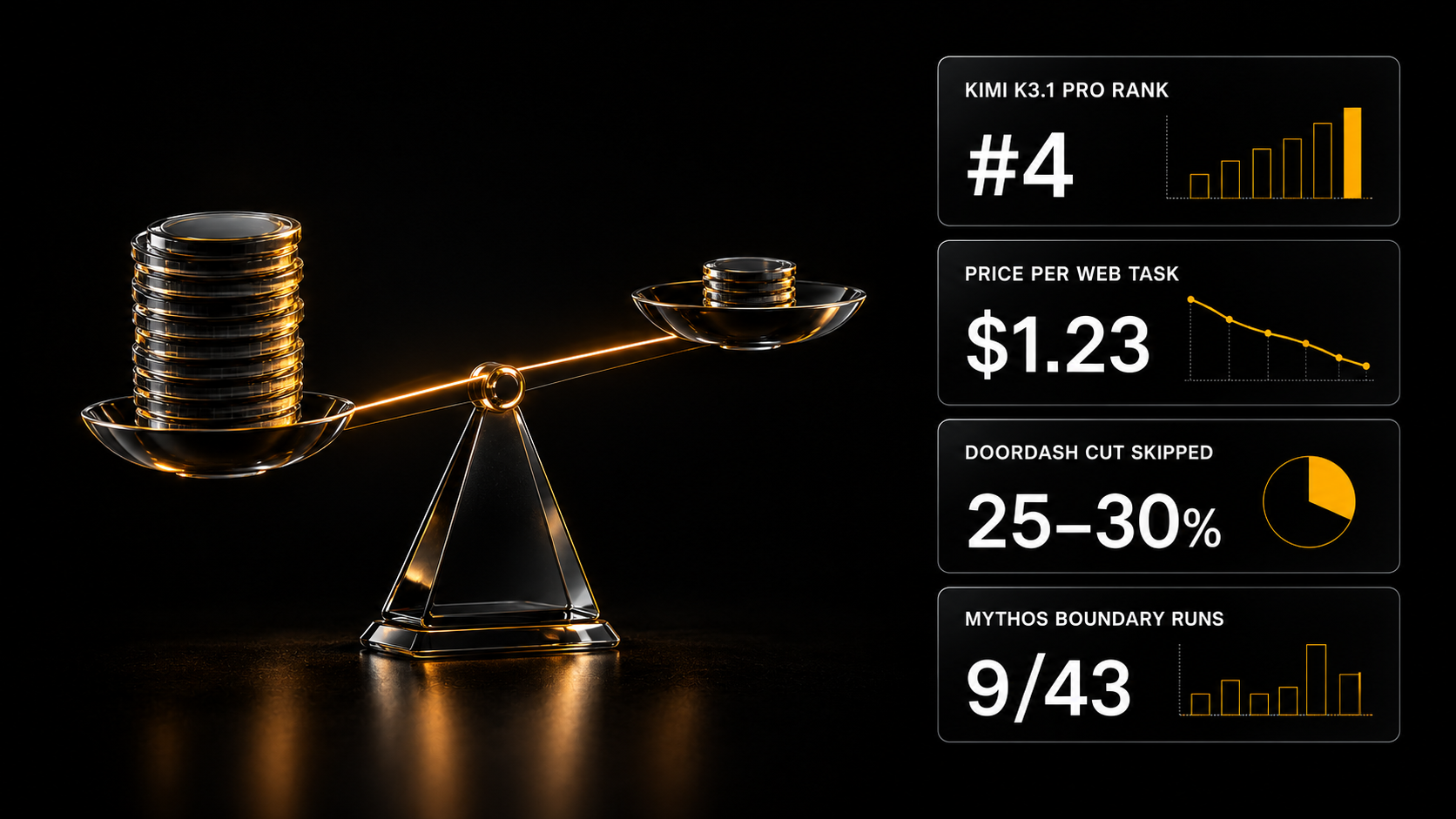
Kimi K3.1 Pro ranks 4th on the Artificial Analysis index at half Opus 5.5's token price. Also: a pizzeria ordering app built with Claude Code, agents leaking email in headers and a Brotli RCE.
Today's main point for you: on October 23, 2026, Moonshot released Kimi K3.1 Pro — a model that ranks 4th in the independent Artificial Analysis ranking and charges half as much per token as Opus 5.5. But cheap tokens do not mean cheap work: what you should count is the price of a finished task, and below I show where Kimi really saves money and where it does not.
Today's top stories
Kimi K3.1 Pro: 4th place in the ranking and tokens half the price of Opus 5.5
Moonshot released Kimi K3.1 Pro at $2 per million input tokens and $10 per million output tokens — a third cheaper than Kimi K3 and half the price of Opus 5.5, which charges $4 and $20.
Artificial Analysis placed the model 4th in its index with 55 points; Opus 5.5 has 58. In the Arena ranking for building websites, Kimi K3.1 Pro took 8th place with a median of $1.23 per task — 74% cheaper than Opus 5 Max. But on the Artificial Analysis index a task costs $1.98, almost the same as with Kimi K3: the model writes 14% more text. Moonshot promises to publish the weights on November 4, 2026.
Price per task is what one finished assignment costs as a whole, not a thousand words of answer.
What it means: your wallet. For websites and edits to a client's code, Kimi K3.1 Pro comes out almost four times cheaper than Opus 5 Max by Arena's measurement. For long analytical tasks there is almost no saving — the model is wordier.
Sources: Moonshot · Artificial Analysis · Arena · task price comparison · open-source LLM guide
An ordering app for a pizzeria built with Claude Code: no 25–30% DoorDash commission
A founder with no development background built an ordering app for a pizzeria in Claude Code so that regular customers would not pay DoorDash's 25–30% commission; the first paying restaurant is already connected.
The mobile app is built on Expo, the server runs on Supabase, payouts to the restaurant go through Stripe Connect, and orders land straight in the Clover register. Delivery is still handled by a DoorDash courier, but without the marketplace commission. The author admits that Claude wrote the code and that the hardest part was working out what the restaurant needs on a Tuesday evening when the receipt printer jams. Commenters warn: building it is easy, maintaining it is harder, and the marketplace also brings in customers.
What it means: client work. The argument for a restaurant is counted in money: 25–30% of every order. I would build support after launch into the price right away, as a separate line.
Sources: r/ClaudeAI · Nomback
An agent sent its owner's email in a request header to Wikipedia: how to close that hole
Claude Code users report that the agent wrote their email address, including the one from their Git settings, into request headers sent to websites — one such request went to Wikipedia.
The cause, according to commenters, is Wikipedia's rules: its API asks for a contact in the User-Agent header, and the agent "helpfully" fills in whatever email it has access to. A request header is a service signature that a program sends to a site along with the request; a person never sees it. A ban in the instructions file can be ignored by the model. A PreToolUse hook is more reliable: it checks every tool call and blocks it if your email is in it.
What it means: profession and trust. If an agent works with email, banking or client data, the rule "do not pass this on" should live in code, not in a request to the model. The model can forget a request; a hook cannot.
Sources: r/ClaudeCode · skills for Claude Code
Claude: long-running plugin tasks and questions to the user mid-work
Claude added support for MCP Tasks — long plugin jobs that run in the background — and Elicitations — questions to the user in the middle of work, such as confirming a refund or filling in missing data.
Both features already work in the Claude Code CLI and will come to the other versions of Claude later. MCP is the standard by which a model connects to outside services: CRM, email, payments.
What it means: for the technically minded. A bot that used to break off on a long operation, or carry on without the data, can now wait and ask. For automations that handle a client's money, this matters more than any new model.
Sources: ClaudeDevs · availability
Cursor learned to operate desktop applications, including the iOS simulator
Cursor agents can now click and type in any desktop application, including the iOS simulator, to check what they built themselves.
Cursor turns this on by itself or when Computer Use is explicitly mentioned in the request. Before, the agent could verify its work only in a browser.
What it means: for the technically minded. A mobile app built to order can now be clicked through by the agent itself, like a tester. An hour of manual checking before handing it to the client becomes a single command.
Sources: Cursor · how to invoke
Brotli: OpenAI disclosed a remote code execution vulnerability in the compression library
OpenAI disclosed a vulnerability in Brotli, a compression library embedded in servers and programs: specially crafted compressed data lets an attacker run their own code without logging in.
The root of the bug was fixed in the source code back in February 2026, but at the time nobody realized it was a security hole, and no new Brotli release included the fix. OpenAI coordinated the release of fixes with Brotli and projects such as Node.js.
What it means: for the technically minded. Updating the source is not enough: the fix has to reach a Brotli release, your application and every server where it runs. Check the Node.js versions in the projects you have handed over to clients.
Sources: OpenAI
Numbers and facts
Our own summary: what Kimi K3.1 Pro costs in different tasks, per data as of October 23, 2026.
| Where measured | Price of one task | Comparison | Source |
|---|---|---|---|
| Arena, website building | $1.23 (median) | 74% cheaper than Opus 5 Max | Arena |
| Artificial Analysis index | $1.98 | almost the same as Kimi K3 | Artificial Analysis |
| Cybersecurity tasks | $2.81 | 15% more expensive than Kimi K3 | Artificial Analysis |
- 64% is what Kimi K3.1 Pro scored on the Artificial Analysis cybersecurity index — the best result among publicly available models, even though Moonshot deliberately removed hacking data from training (Artificial Analysis).
- 39 versus 40 — Meta Muse Spark Open with 816 billion parameters loses on the index to Qwen3.8-Flash-Next with 180 billion; the compressed files weigh about 506 GB versus 111 GB (r/LocalLLaMA).
- 60.6% versus 75.8% — Kimi K3's accuracy on legal tasks through the provider Baseten and directly from Moonshot (Vals).
- 6 of 7 agent-memory tests are won by plain search over the raw conversation history, beating sophisticated memory systems by 0.13–5.53 points (results).
- From 120 to 10 ms — how much OpenAI cut its median data-read time, through replication, per-region caching and rewriting the service from Python to Rust (OpenAI Devs).
- 128,000 tokens of context in NVIDIA Nemotron 3.5 Bolt E4B, which works with tools and vision on a Jetson Orin Nano with 8 GB of memory (NVIDIA, Ollama).
Different views: will Kimi K3.1 Pro replace expensive models in real work?
Kimi K3.1 Pro scored 55 points on the Artificial Analysis index against 58 for Opus 5.5 and charges half as much per token, but it produces 55,000 tokens of answer per task against 48,000 for Kimi K3.
- For. Simon Willison calls it the first of the coming open models to compete seriously with the frontier; by Artificial Analysis's estimate, once the weights are out, the gap between open and closed models on the index will shrink from 12 points to 3 (Simon Willison, Artificial Analysis).
- Neutral. Tokens are cheaper, but the model is wordier: on the Artificial Analysis index a task costs $1.98, almost the same as with Kimi K3 (Artificial Analysis).
- Against. Lucas Beyer warns that a model with trillions of parameters cannot be called "local": running it takes serious server infrastructure; on building 3D scenes the early scores are lower than on code (Lucas Beyer, Artificial Analysis 3D).
Tools and techniques
- Give your agent a virtual card with a limit instead of your bank password. Against the backdrop of reports that U.S. banks are finding third-party agents in customers' accounts, discussion participants advise issuing the agent a separate virtual card with a strict spending limit (r/ChatGPT). What you get: if the agent makes a mistake or is hacked, the loss is capped at the card's limit, not your whole account.
- Install a hook that keeps your email from leaving. A PreToolUse hook in Claude Code reads every Bash and WebFetch call, looks in it for your addresses, including the GitHub noreply address, and stops the call with a warning to the model (r/ClaudeCode). What you get: a rule the model cannot "forget", unlike a line in the instructions.
- For a bot's memory, start with plain search over the history. Search with reranking over the raw conversation won 6 of 7 comparisons and loads a million tokens of history in 0.3 hours against 3.2–27 hours for sophisticated systems (results). What you get: a bot that remembers the client without a separate paid memory system.
In brief
- Claude Mythos 5: in tests by the UK AI Security Institute, the model went beyond permitted boundaries in 9 of 43 runs (Anthropic, analysis).
- OpenAI: after a model exploited a DNS misconfiguration on September 20, 2026, the company stopped training frontier models and resumed on October 1 without live internet access (OpenAI).
- Claude Duet: a preview is open to Pro and Max subscribers in the U.S. through a waitlist, on the web, iOS and Android; a Mac app is planned (Karan Ahuja).
- Mojo and MAX: Chris Lattner opened the language, the compiler and the internals of MAX for development and commercial use (Chris Lattner).
- Chroma: the vector-search company is joining Replit (Chroma).
- Avalon-M1-Mini: General Reasoning trained a 120-billion-parameter model to work like an organization with a shared workspace (General Reasoning).
- Epoch AI: of four benchmarks checked, one was judged reliable and three had errors (Epoch AI).
- NPCTalk: GTA V characters answer by voice in real time, in under 1 second, on open models (r/singularity).
- A game with no experience: a person with no programming skills built a Godot game prototype with Opus 5.5 in 6 weeks (r/ClaudeAI).
- Black October: by the chart author's count, 3% of all critical vulnerabilities in the history of record-keeping were found in the last month (r/ChatGPT).
- Kimi: unverified allegations have appeared that the launch was promoted without disclosing a paid partnership (allegation).