Your own visual style instead of somebody else's: why train a LoRA
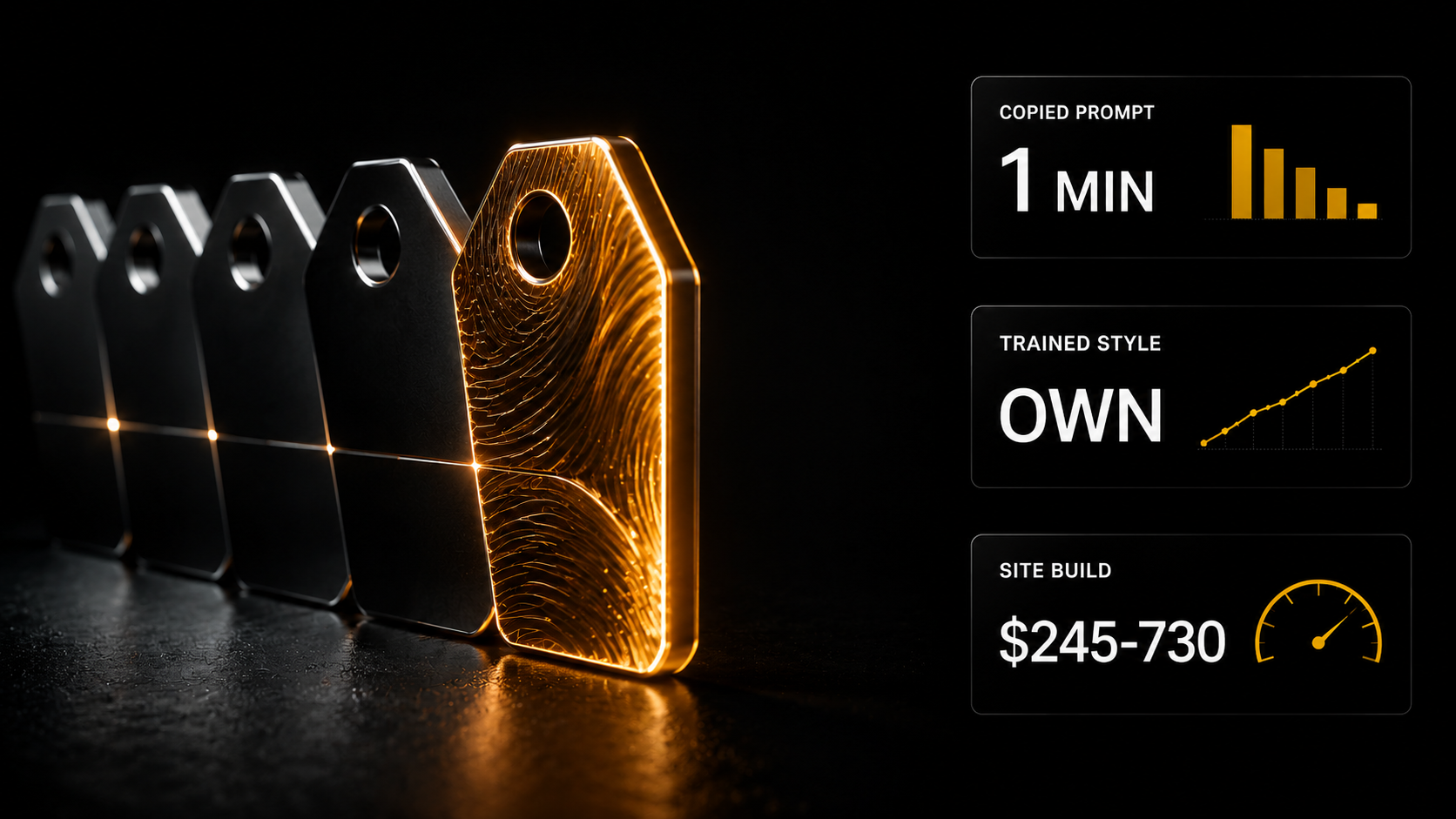
Everybody uses the same models and similar descriptions, and the feed looks identical. A prompt is a poor cure: a competitor repeats the phrasing in a minute. Below is a way to get a manner that resists copying, and who actually needs it.
Everybody uses the same models and similar descriptions, and the feed looks identical. A prompt is a poor cure: a competitor repeats the phrasing in a minute. Below is a way to get a manner that resists copying, and who actually needs it.
---
Everybody generates identically
Open the feed of any niche where people use generation. The images differ in subject and in nothing else.
The same smoothness, the same compositions, the same colour manner. The reason is simple: everybody uses the same models and similar descriptions.
A prompt is a poor cure. You can add ten clarifications about style and get the same thing anybody adding those ten clarifications gets. A phrasing gets copied in a minute.
There is a way to get a manner that resists copying.
What a trained style is
You train a model on your own images and it applies your visual manner to new frames.
Not "in the style of such-and-such artist" but in yours: your colours, your composition, your texture, your way of working with light.
A trained style lives in your profile and gets dropped into any subsequent generation.
Alongside sit two more trainable assets: a character — a permanent figure with an unchanging appearance — and a voice clone for narration. Three together give recognisability: one figure, one manner, one voice from one piece of material to the next.
How this differs from a prompt
The difference is fundamental and it explains why the effort is worth it.
A prompt is a description in words. You say "minimalist, muted tones, plenty of air". The model interprets. Slightly differently every time, because words describe the visual approximately.
A trained style is a shown example. The model has seen your work and reproduces the manner rather than an interpretation of a description.
Three consequences:
Stability. A series of twenty images holds one manner without each being adjusted.
Precision. What you could not have described in words — and describing the visual in words is nearly impossible — carries across.
Non-copyability. A competitor reads your prompt and repeats it. Your trained style, no.
Who genuinely needs this
Honestly, because not everybody.
People with a recognisable manner. An illustrator, a designer, a photographer with their own hand. Training carries what you already have into generation.
People working with a brand. A company has a visual language and the material has to land in it. A trained style is a way of not explaining it from scratch every time.
People making series. A line of listing images, a set of covers, a long content plan. Stability matters more than one-off beauty.
Who does not need it: if you make one-off images for different tasks in different aesthetics, training a style is wasted work. A prompt will do.
What you need to train one
A set of your own images in one manner. The key phrase is one. If the set mixes different styles, the model will average them and produce mush.
Enough of them. A stingy set gives a weak effect: the manner is guessable but does not hold.
Uniform in what matters, varied in the rest. One style but different subjects, angles and compositions. Otherwise the model learns a particular subject rather than a manner.
Clean sources. No watermarks, captions or extraneous elements — those get into the style too.
And a legal caveat that matters more than the technical part: you may train on your own work. A set of somebody else's illustrations collected from the internet is somebody else's intellectual property, and you will not be able to use the result commercially without consequences.
Three assets together: what that gives
The point becomes visible when they work as a set.
The character solves the main problem of series — the face does not change from frame to frame. Without it a commercial line cannot be assembled.
The style makes every frame look like one project rather than a collection from different sources.
The voice closes it: the clips sound recognisably the same.
The practical consequence for commissions. A client who received three trained assets received not a set of files but a production system: from then on material gets made in their manner, with their character and their voice — quickly and without you.
That is a fundamentally different product from "I'll make you twenty pictures".
How this sells
A visual system as a service. Not "I'll do your design" but "I'll assemble the manner, train the style, give you the rules and examples — from then on the material gets produced in it".
What gets delivered: the trained style, a set of starter material, a description of the system — what is constant, what is variable — and instructions for use.
Why people pay more for that than for pictures. Because the result lives on after you: the client keeps generating in their own manner rather than commissioning afresh each time. One-off work ends; a system does not.
The price range for comparison. By my scrape of 848 listings: an image individually — $12–35, a set of listing images — $245–730, a system or pipeline — $490–1 460. The median for one-off work is $30–75.
A trained style belongs on the third line rather than the first.
And a caveat on handover. If the style was trained on the client's work and gets handed to them, that goes in the contract along with rights in the result passing on full payment.
The order of work if you are starting
Step 1. Determine whether you have a manner. Lay out twenty of your works and see what they have in common. If there is nothing in common, there is nothing to train yet — first the manner.
Step 2. Assemble a uniform set. One style, different subjects.
Step 3. Train it and test it on a new task. Not on something from the set — on something the model has not seen.
Step 4. Judge the stability. Generate five frames in a row and see whether the manner holds. That is the main criterion rather than the beauty of one image.
What is available on the platform
LoRA training in Gen AI — training your own style on your own images. It lives in your profile and gets dropped into any generation.
Character training — a permanent figure. The voice trainer — a clone for narration.
Image generation — thirty models, $0.12–0.25 per generation. The photo editor — thirty-four models, $0.12–0.50. Upscaling — six models.
Paid from the wallet on use, the price visible before you press, money returned for anything not delivered.
AI Workflow — a chain applying the trained style to a list of tasks, with an iterator running it across the whole set. Build it once and use it permanently.
The creative assistants — fourteen of them: an art director, a graphic designer, an illustrator, prompt generators. The art director helps articulate what exactly is constant in your manner. From the Basic plan.
Image generation courses come with the Plus plan, or $9 one-off, or 1 000 experience points.
Registration is free and opens three days of full Basic access.
Where to start today
One action, and it is not about training.
Lay out twenty of your works and write down what recurs in them: colours, composition, light, texture, spacing.
If the list comes to fewer than four points, you do not yet have a manner but a collection. And that is not a training problem: the manner has to exist first, then it can be carried across.
If it is longer, you have just described what a prompt cannot copy. From there it can be trained.
---
A technique from the course that works without training
Training a style is the top level. There is a simpler way, and it is in module 6.
Style Reference. You saw a good visual — you upload the image as a reference with the `--sref` parameter, and the model takes on the aesthetic, the colours and the atmosphere, applying them to your subject.
A library of 4 000+ ready style codes comes with it. So you do not have to find a reference — you can take a ready code and get a predictable manner.
Plus Character Reference with the `--ow` parameter — for a face or a mascot: the model remembers the appearance and holds it in any scene.
The difference from a trained style. A reference works immediately and needs no set of work, but the manner remains somebody else's. A trained style is yours and resists copying.
And a ready solution with consistency built in
The AI influencer with memory from the archive: you set a reference face and from there the system holds consistency across every generation itself and plans content a week ahead.
Module 6 — Plus; the pipeline — Make, N8N and Full.
---
What to read next
[Why an AI character looks plastic](/en/blog/why-ai-character-looks-plastic) — the first of the three trainable assets.
[A voice clone instead of a narrator](/en/blog/voice-clone) — the third.
[AI for designers](/en/blog/ai-for-designer) — how a series system gets set.
[Photo editing with AI](/en/blog/photo-editing-with-ai) — when you correct rather than create.
[AI video generation in 2026](/en/blog/ai-video-generation-guide) — the full guide to video models.