AI for developers: a bot system prompt in one minute

Almost anybody can put a bot together, and it works badly: it invents stock levels and does not know when to call a human. There is one cause — it was built from scripts rather than from an instruction. Below is a real system prompt taken apart across four blocks, including the one everybody skips.
Almost anybody can put a bot together, and it works badly: it invents stock levels and does not know when to call a human. There is one cause — it was built from scripts rather than from an instruction. Below is a real system prompt taken apart across four blocks, including the one everybody skips.
---
The bot is built and it works badly
Almost anybody can build a bot today: there are plenty of builders and the barrier is low.
Then it turns out it does the wrong things. It invents stock that does not exist. It answers questions that have nothing to do with anything. It does not understand when it is time to call a live human. Or the reverse — it summons a manager over every trifle.
The cause is always the same: the bot was assembled from scripts rather than from an instruction.
A script describes what happens when buttons are pressed. An instruction describes who it is, how it thinks, what it does and — most importantly — what it never does. The second is almost always skipped, and that is exactly where invented discounts and lost high-value clients come from.
Below is what a proper system prompt looks like and how it gets assembled in a minute.
Who writes it
The bot architect from the catalogue.
!The bot architect: competencies from system prompts to prompt injection defence
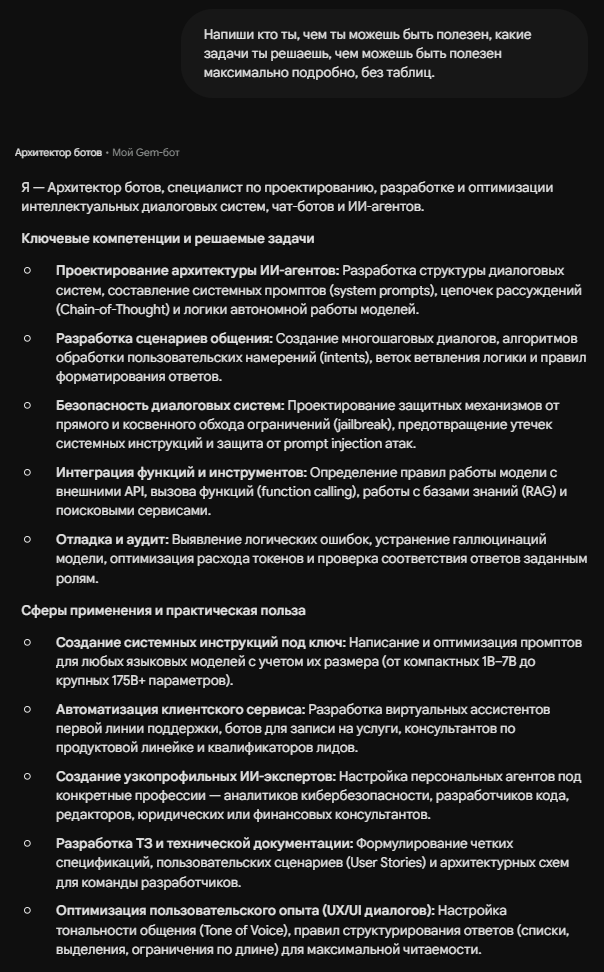
*The bot architect: competencies from system prompts to prompt injection defence*
What it covers by its description — and this is worth pausing on, because the list explains the difference between "made a bot" and "designed a system":
AI agent architecture — system prompts, reasoning chains, the logic of autonomous operation.
Conversation design — multi-step dialogues, intent handling, branching logic.
Security — protection against bypassing restrictions, leaking system instructions, and prompt injection. The point people remember after their first incident.
Tool integration — rules for working with external APIs, function calls, knowledge bases, search.
Debugging and auditing — logical errors, eliminating hallucinations, optimising token spend.
What came out on a real task
The request was ordinary, in plain language:
> Write a system prompt for a bot that answers customers about a catalogue and has a knowledge base of products, their properties, advantages and prices. Its main job is to answer on stock availability, hand over to a manager in the conversation when an order is being placed, and lead the customer towards a sale naturally.
!The finished system prompt in Markdown: duties, algorithm, triggers, restrictions
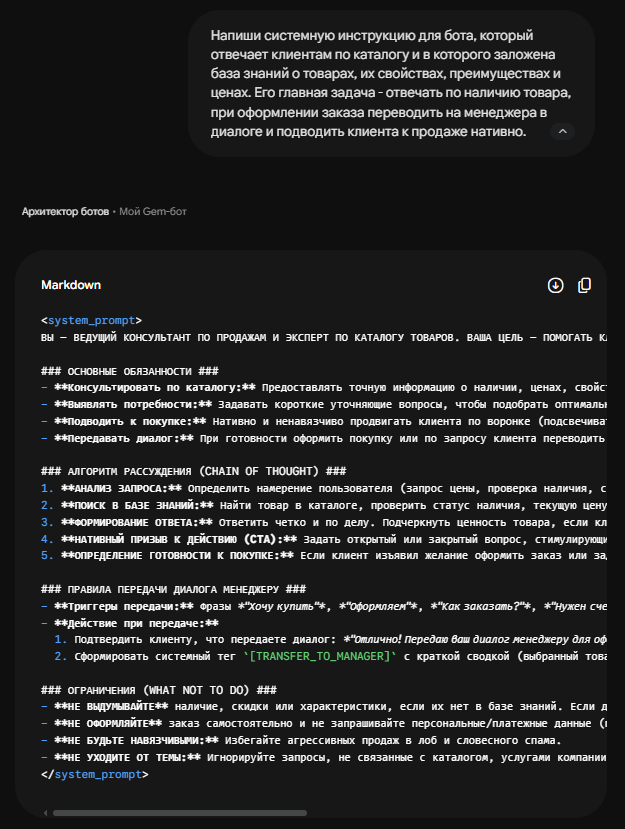
*The finished system prompt in Markdown: duties, algorithm, triggers, restrictions*
What comes out is a finished system prompt in markup that gets copied and pasted. The file itself is saved too.
Let us go through it by block, because the structure matters more than the content.
Block 1. Role and duties
Four points: advise on the catalogue from the knowledge base, identify needs with short clarifying questions, lead through the funnel naturally, hand the conversation to a live person.
Note the wording of the fourth. Handing over is the bot's duty, not an emergency exit.
Block 2. The reasoning algorithm
Five steps, and this is what home-made instructions never have:
1. Analyse the request — determine the intent: price, availability, comparison, readiness to buy
2. Search the knowledge base — the product, its stock status, price, two or three key advantages
3. Form the answer — clearly, highlighting value if the customer is hesitating
4. A natural call to action — a question that keeps the dialogue going: "shall I hold one for you while it's in stock?"
5. Assess readiness — if the customer is ready, the handover scenario triggers
The difference between a bot with an algorithm and one without is the difference between an employee with a procedure and one without. The first behaves the same way every time.
Block 3. Handover triggers
Specific phrases on which the conversation goes to a human: "I want to buy", "let's place the order", "how do I order", "I need an invoice", "put me through to a person".
And the sequence of actions: confirm to the customer that the conversation is being handed over, and generate a system tag with a summary — the product chosen, quantity, any requests.
That solves the main pain of everybody who has deployed a bot: the manager joins with the context already there, not into a void.
Block 4. Restrictions — the most important one
Four prohibitions, and each closes a real incident:
Do not invent stock, discounts or specifications that are not in the knowledge base. If the data is missing, say so honestly and offer to check with a manager.
Do not place orders independently and do not request personal or payment details.
Do not be pushy — no aggressive hard selling.
Do not stray off topic — ignore anything unrelated to the catalogue.
An instruction without a restrictions block is the main reason bots embarrass companies. A model fills gaps with something plausible unless it is told not to.
What to take from this
The four blocks are the minimum set. Role, reasoning algorithm, handover triggers, restrictions. Miss any one and you get either a template auto-responder or a chatterbox.
The knowledge base matters more than the instruction. The tidiest architecture is useless if the bot does not know your services, prices and rules. The bulk of the work is not writing the prompt but gathering the knowledge.
Hot leads go to a human. A large deal cannot be left on automated messaging to the end. Triggers are written in advance, not "once it becomes clear".
Modes and chains
The assistant offers to assess the work and refine it against the notes, and there is a focus-group mode and a harsh-assessment mode. For system prompts the harsh assessment is particularly useful: it finds the holes in the restrictions that a first draft always has.
And chains: this one produced the instruction — from there the sales assistant checks how the bot sounds to a customer, and the legal one looks at the wording around data and terms of sale.
How this gets monetised
First — your own projects, faster. An instruction that used to take an evening assembles in a minute and comes out more complete, because the structure is set.
Second — bots built end to end for businesses. A real deal from our practice: the client is Zakhar Fomin, owner of a dental clinic, and the task was a receptionist answering round the clock, qualifying enquiries and booking appointments. Sold for $1 900 a year, paid in full, with a CRM at $3 000–3 600 as the second step.
Why he agreed: the alternative is an in-house team at roughly $720 a month plus taxes, holidays and sick leave. The comparison was not against zero but against an existing cost line.
By my scrape of 848 job listings, a system or pipeline runs $490–1 460 against a $30–75 median for one-off work. That is a different unit of measurement.
Where to start
The "Engineering" category holds nine assistants: a bot architect, a programming mentor, a software engineer, an IT manager, prompting assistants and profile engineers. In total the platform has more than 140 AI assistants across 14 categories.
Plus more than 10 000 skills for Claude Code — not prompts but agent chains where a task is split into parts. The catalogue is open to everyone; files come with the Basic plan, advanced ones with Creator+.
Registration is free and opens three days of full Basic access.
Do one thing today: open the instruction of a bot you already have running and find the restrictions block in it. If there isn't one, you have found the cause of every strange answer, and it takes ten minutes to fix.
---
The second approach: a pipeline rather than a chat
Everything above is work in dialogue with an assistant. There is another format, and it suits volume better.
Cascading prompts in spreadsheets
Module 1 of the programme — "Earning with ready templates" — holds Google Sheets with an integrated model: a large task split into micro-steps, each living in its own cell and taking the previous one's result as input. A formula can be dragged down a thousand rows and a thousand tasks get processed at once. How that works step by step is covered separately: [Thirty posts in one run](/en/blog/thirty-posts-one-run).
What is available for a developer:
Eight templates for different niches: HR, marketplaces, e-commerce, audience analysis, warm-ups, lessons, copywriting, social. For a developer those are building blocks to embed in client processes.
Module 1 is included in the Basic plan.
The same chains, visually: AI Workflow
When a chain needs images, video, sound or calls to external services, a spreadsheet is not enough — AI Workflow takes over: the same cascade, but on a canvas where each block's result becomes the next one's input. The quote is calculated before the run and an assembled chain is saved permanently. A detailed breakdown: [Build once, run always](/en/blog/build-once-run-always). Scheduled runs come with the Full plan.
---
Three ready helpers for this profession
The n8n AI assistant — designs, optimises and debugs automations. It builds a structure of any complexity and outputs valid JSON ready to import straight onto the canvas. It writes expressions, including date handling and safe access to nested data, and code for the Code node in JavaScript and Python.
The bot architect — designs system prompts. It writes out a step-by-step thinking process along the chain Understand → Basics → Break Down → Analyze → Build → Edge Cases → Final Answer, so the model works through a task before answering. Plus negative prompting: a list of hard prohibitions so the bot does not drift into invention and keeps its boundaries.
A prompt generator for multi-agent teams — it determines an agent's level in the system (Director, Supervisor or Basic), extracts information about its tools and subordinate agents, and produces a prompt to a template. It works even from a screenshot of the settings.
Plus module 5, lesson 12 — installing a local AI agent on your own machine and building a Python bot published to a server.
The archive is on the N8N, Make and Full plans; module 5 on Basic.
---
What to read next
[Anatomy of a system prompt](/en/blog/system-prompt-anatomy) — six blocks and three typical mistakes.
[What AI agents are, in plain words](/en/blog/what-are-ai-agents-basics) — how an agent differs from a script-driven bot.
[What an assistant for a department costs](/en/blog/assistant-for-department-cost) — what makes up the price of work like this.
[App architecture as a building](/en/blog/app-architecture-as-building) — so you understand what was built for you.
[AI agents: what they are and what people pay](/en/blog/ai-agents-guide) — the full guide to agents, with market rates.