A 3D model from a product photo: what it is for and who pays for it
A client needs the product not in a photograph but in three dimensions: to rotate on a listing, drop into another scene, film with a camera move. That used to mean a shoot or manual modelling. Below is what comes out of ordinary photos, where the limits are and how it sells.
A client needs the product not in a photograph but in three dimensions: to rotate on a listing, drop into another scene, film with a camera move. That used to mean a shoot or manual modelling. Below is what comes out of ordinary photos, where the limits are and how it sells.
---
Not enough photographs and three dimensions needed
A task that used to be solved only by a shoot or by manual modelling.
The client needs the product not in a photograph but in three dimensions: to rotate on a listing, to place in a different scene, to show from every angle, to drop into a clip.
The classic route: either a photo session with dozens of angles, or a 3D artist modelling by hand. The first is expensive and gives no real volume, the second is expensive and slow.
There is a third route: the model gets assembled from ordinary photographs. From one, and better from two to four taken from different sides.
Let us go through what actually comes out and who to sell it to.
What can be done
Two directions, and they differ in applicability.
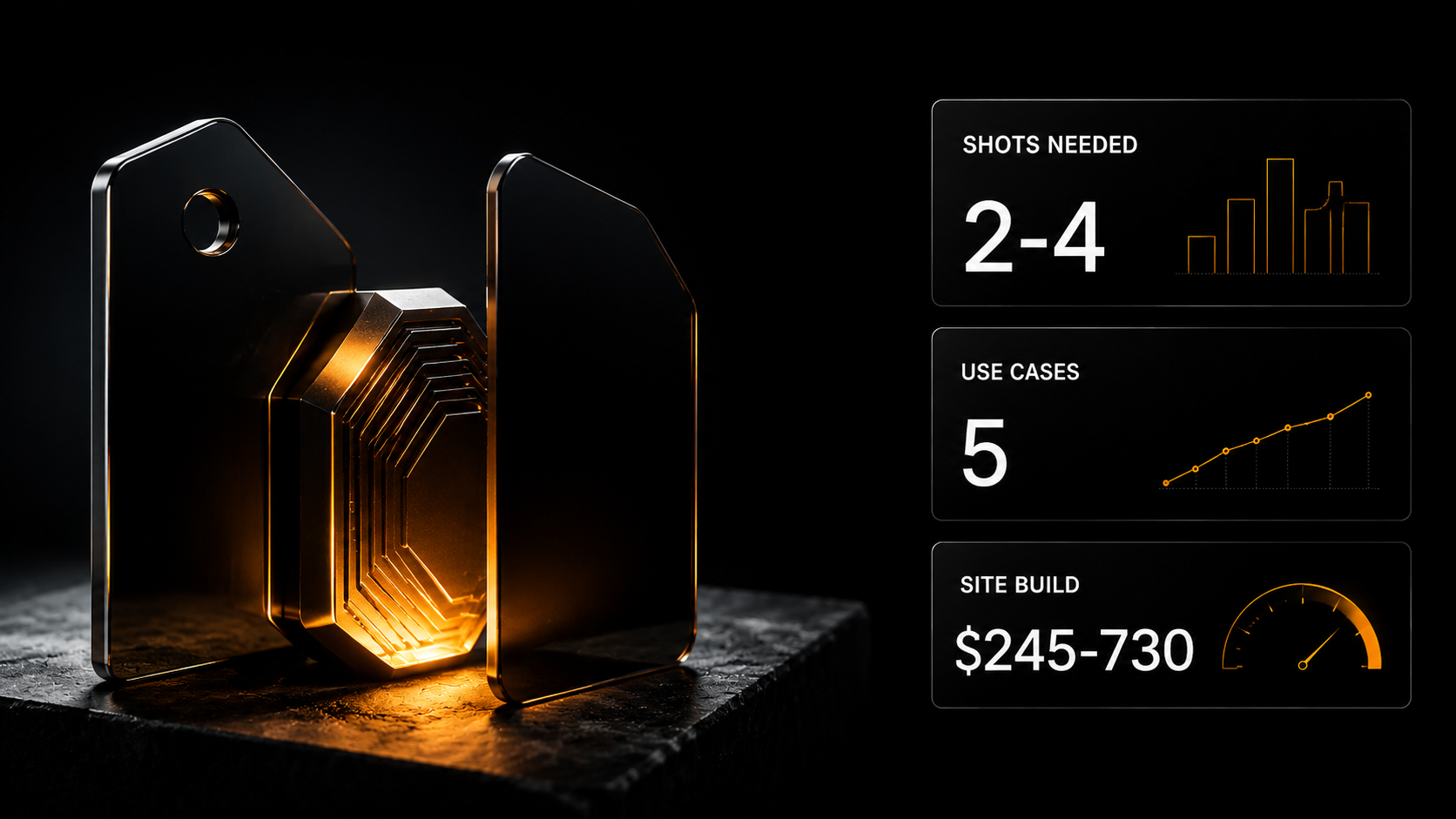
From a photograph into three dimensions. You upload a shot of the product and get a three-dimensional model. The more angles as input, the more accurate the result: two to four shots are noticeably better than one.
From text into three dimensions. You describe an object in words and get a model. That works when accuracy is not needed: props, set dressing, a generic object.
The price range for generating: $0.36–0.72 per model depending on the tool. Paid from the wallet on use, the price visible before you press.
Where this gets used
Five scenarios, from the most widespread to the narrowest.
A listing with rotation
The buyer rotates the product and looks at every side. For marketplaces and online shops that noticeably raises trust: the objection "I can't see what it's really like" gets removed.
The most widespread scenario, and the easiest to approach: the seller already has photographs.
The product in any scene
With three dimensions you place the object anywhere: in an interior, on a table, in somebody's hands. With no reshoot for every scene.
That replaces a product photo session for a substantial share of tasks.
Clips with camera movement
A 3D model lets you fly a camera around the product. For an advertising clip that is the cinematic shot people usually rent a studio for.
Prototypes and presentations
Showing an idea before manufacturing. To an investor, a partner, at a trade show.
Games, apps and augmented reality
The narrowest niche by demand but with high fees.
Where the technology falls short
Honestly, because what you take on depends on it.
Fine detail. Threading, engraving, fabric texture, thin elements — get lost or distorted.
Transparent and shiny. Glass, chrome, mirrored surfaces — the hardest category. A photograph of such an object consists mostly of reflections, and the model takes those for form.
Exact correspondence to the original. What you get is similar rather than identical. For a product where every detail matters — markings, precise shape, composition — that is a fundamental limit.
Text on a surface. Lettering on packaging does not transfer correctly and gets added separately.
Complex geometry. Objects with cavities, cut-outs, many separate parts.
The practical conclusion: simple shapes with matte surfaces work best. A mug, a box, footwear, furniture, appliances without gloss.
How to get a decent result
Four rules, all about the source rather than the tool.
Shoot from several sides. Two to four angles change the result more than the choice of model. Front, side, top, back.
Even diffused light. The model takes hard shadows for form.
A plain background. The less clutter around, the more cleanly the object gets separated.
The whole product in frame. Anything cropped does not get completed.
The check is simple: if you would not have understood the object's shape from those photographs yourself, the tool will not either.
How this sells
Who buys. Marketplace sellers, online shops, furniture and appliance manufacturers, people making presentations and catalogues.
How to approach it. Not with an offer of 3D. With an observation about their listing: in the questions on the product people ask about dimensions and what it looks like from another side. Which means the photographs are not enough.
That is specific and verifiable — and works better than an account of the technology.
What gets delivered: models per item, renders for the listing, and where needed a clip with a camera move.
The price range for comparison. By my scrape of 848 listings: marketplace listing images — $245–730 per set, an image individually $12–35, the median for one-off work $30–75.
3D logically sells not on its own but as part of a listing set. A standalone model is per-item work; a set with three dimensions and angles is an entirely different fee.
And honestly about the cost: $0.36–0.72 per generation against a set in the hundreds of dollars. The spend runs to fractions of a per cent; the main thing is to build it into the quote, the way a printer builds in paper.
What is available on the platform
Gen AI, the "3D generation" mode — eight models: from a photograph, from text, from several angles. The price per generation is $0.36–0.72.
Product Shot — product photography: the item gets placed into a studio scene or into a model's hands with no real shoot. Two models, $0.12.
Background removal — for cleanly separating the object before processing. $0.12.
Upscaling — raising the resolution of renders for print and large banners. Six models, $0.12–0.40.
AI Workflow — if there are many items: a chain of "remove background → build the model → render the angles → assemble the listing", with an iterator running it across the whole catalogue in one go. The quote is visible before the run and money comes back for steps not completed.
The e-commerce assistants — thirteen of them, including content specialists per platform and a visual merchandiser. From the Basic plan.
Registration is free and opens three days of full Basic access.
Where to start today
One action. Take one of your products, or a seller friend's, photograph it from four sides on a phone in even light, and build a model.
Not to sell. To see where the technology copes and where it does not on your type of product — an answer you cannot get from an article.
If your product is matte and simply shaped, you have just gained a service your competitors in the niche do not offer.
---
Where this sits and what goes with it
In Gen AI the 3D generation mode holds eight models at $0.36–0.72 per model. From text, from a photograph, from several angles.
What gets used alongside for the same task:
Background removal — one tool, $0.12. Cleanly separating the object before building the model.
Product Shot — two models, $0.12. The item gets placed into a studio scene or into a model's hands with no real shoot.
Upscaling — six models, $0.12–0.40. Enlarging renders for print and large banners.
Auto-Shine from the automations archive — if there are many items: the pipeline turns a product image into selling content, handling a catalogue rather than one product.
The cost of a set against a $245–730 fee per listing runs to fractions of a per cent.
---
What to read next
[AI for marketplace sellers](/en/blog/ai-for-marketplace-seller) — where this goes.
[Photo editing with AI](/en/blog/photo-editing-with-ai) — preparing the source material.
[Relaunching on a marketplace](/en/blog/marketplace-relaunch) — the full pipeline of work.
[What a clip actually costs to make](/en/blog/video-production-cost) — what the generations come to.
[AI video generation in 2026](/en/blog/ai-video-generation-guide) — the full guide to video models.