DeepSeek V4 Flash Vision and Ox Alpha — AI Digest
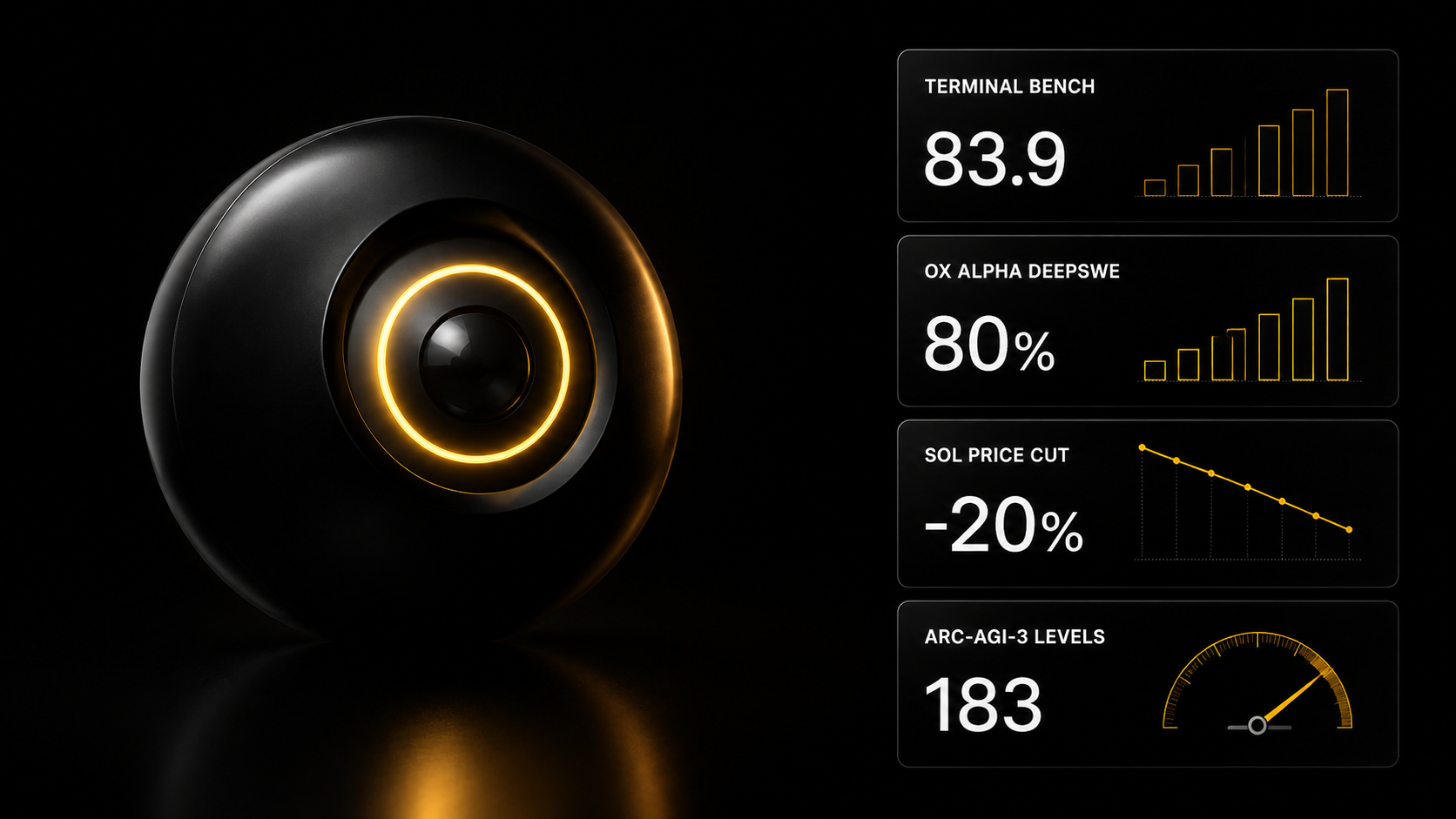
DeepSeek shipped V4-Flash-Vision-Exp at 83.9 on Terminal Bench 2.1 with images at Flash pricing. Stealth model Ox Alpha cleared 80%+ on DeepSWE tasks, and OpenAI cut GPT-5.6 Sol pricing by over 20% for three months.
Today's top stories
DeepSeek ships V4-Flash-Vision-Exp: 83.9 on Terminal Bench 2.1, images at Flash pricing
DeepSeek released DeepSeek-V4-Flash-Vision-Exp on 21 August 2026 — an image-capable version of its fast model that the company says preserves V4-Flash text performance while approaching Opus-4.8 on multimodal agent work (DeepSeek announcement). The published table shows 83.9 on Terminal Bench 2.1, 75.9 on Toolathlon-Verified and 64.3 on Chartography (table breakdown). Mixed text-and-image input runs through the API, where an image costs between 117 and 384 tokens and is billed at Flash rates (API details). DeepSeek also opened a Files API: upload an image once, reference it by id afterwards, and stop resending the payload on every request (Files API announcement).
Stealth model Ox Alpha posts 80%+ on DeepSWE tasks against Fable's 65%
An unnamed, unattributed model going by Ox Alpha scored above 80% on ten DeepSWE tasks, against 65% for Fable and 52% for GPT-5.6 Sol (measurement). A stealth model is one a lab puts into public hands anonymously, to collect unbiased feedback before it announces anything. Builders described it as tearing through their internal benchmarks, and one merged eight pull requests in a row on its approval (first reaction, end of day). Guesses converged on Zhipu's GLM family: Tim Dettmers read the fast output and weak partial prefill as signs of fewer active parameters (analysis), while other observers narrowed it to GLM-5.3/5.4 Vision (observation). Third-party clients had it the same day (Hermes Agent and OpenRouter, Cline).
OpenAI cuts GPT-5.6 Sol pricing by more than 20% for three months
OpenAI cut GPT-5.6 Sol pricing by over 20% across the API and credit-based products on 21 August 2026, for three months (OpenAI announcement, developer details). The discounts stack: on Devin, Sol now lands 76% below list through 3 October 2026 once promotions combine (Cognition's math), while the Code editor holds its own 50% off through 3 September (Code promotion). Separately OpenAI said Codex reached 20M active users and reset usage counters for every Codex and ChatGPT Work user (OpenAI statement). Teams also got hard spend ceilings: usage is now visible per API key, and monthly limits can be set per organization and per project (announcement).
NVIDIA AVO clears all 183 ARC-AGI-3 levels — on the public set only
NVIDIA's AVO agent reached 100% on ARC-AGI-3: all 183 levels across 25 environments, with no instructions, no stated rules and no stated goals (NVIDIA claim). François Chollet immediately clarified that this is the public demo and tutorial set rather than the full benchmark (Chollet's caveat). Community analysis landed on the same point: the run covered open environments, the private set was not tested, so generalization is not yet demonstrated (discussion). ARC-AGI-3 is a set of interactive environments where the agent has to infer the goal and the rules itself, which is exactly where the gap between memorized and understood shows up most clearly.
Nvidia to pay Poolside roughly $6B to license its model factory
Nvidia will reportedly pay startup Poolside around $6B for a non-exclusive license to its model-development system, plus roughly $1B invested at a $12B pre-money valuation, according to The Information (deal breakdown). The asset is Poolside's "model factory", the system behind its Laguna coding model; 109 employees who worked on Laguna received Nvidia offers. Reaction split: some expect a boost to Nvidia's open-model work, others call it an acqui-hire that ends Laguna as an independent line. A separate argument for open weights landed the same day from David Sacks: legal service Harvey reached state of the art in its domain on the open Kimi K3, at lower cost (post).
Numbers and facts
- Environments beat prompts: Google's EnvHarness and EnvRigger adapt static environments through a plugin layer and policy diagnosis — up to 9 points better on held-out tasks with 9.8% fewer execution steps (paper breakdown).
- Benchmarks got harder: SWE-bench Science adds 119 scientific software tasks where Claude Code with Opus-5 stays under 50% pass@1 (announcement); CADBench puts top models at 24.6% on realistic Fusion 360 work (announcement); AI4AI-Bench tests recursive self-improvement across 10 repositories with a best score of 0.288 (announcement); FACET validated 6,078 executable terminal tasks built from agent skills (announcement).
- vLLM IsoExec removes the rollout-versus-training logprob mismatch caused by floating-point non-associativity: on Qwen3.5-35B-A3B with DAPO on 8×H100 the gap fell from 1.6e-2 to 6.7e-7 at 25.3% overhead (announcement).
- DeepMind's Recirculation feeds deeper-layer activations back into earlier processing at inference time, with no retraining: 60% fewer contextualization errors, 23% lower perplexity, 21% better GSM8K (thread).
- Berkeley's FreeToken: GLM-5.2 at 753B parameters runs at 14.9 tokens per second on a single RTX PRO 6000, and Qwen3.6-35B hits 39.3 tokens per second on an 8GB laptop RTX 4060 — claimed at 2–4x Ollama throughput on consumer cards (measurement).
- Marin 535B-A23B started training: 18.75T tokens on 11 GB200 NVL72 racks over roughly three months, with the run kept open (announcement).
- Our own catalog on 23 August 2026: 10,128 active Claude Code skills, 595 open-source tools, 3,276 automation templates and 338 generation models — AI SKILLS platform figures, not third-party ones.
Different perspectives: does 100% on ARC-AGI-3 prove general reasoning?
The argument turns on one result: NVIDIA's AVO agent cleared all 183 levels across 25 ARC-AGI-3 environments with no instructions and no stated goals (NVIDIA claim). The question is what got measured — the ability to work out an unfamiliar environment, or a fit to one specific benchmark.
For. ARC-AGI-3 environments are interactive, and the agent has to derive the rules and the objective itself: clearing them back to back with no prior knowledge is a qualitatively different result from solving a set of static problems. Long autonomous scenarios are exactly where the research agenda is moving, from Google's environment reshaping to benchmarks like FACET (EnvHarness breakdown).
Neutral. François Chollet, who created ARC, does not dispute the result — he bounds it: what was cleared is the public demo and tutorial set, not the full benchmark (Chollet's caveat). That is not a rebuttal but a reminder that ARC-AGI keeps a private half precisely for claims like this one.
Against. Skeptics in the discussion argue that without a held-out run the result is indistinguishable from benchmark maxing, and propose a simple test — put the same agent into unrelated interactive games it never prepared for (discussion). The same skepticism showed up around open models that day: users found Qwen3.8-27B noticeably weaker on factual recall than version 3.6 once web search was switched off (breakdown).
Tools and techniques
- Routing as search, not as free estimation. Google DeepMind's Pandora's Router treats finding out how good a model would be as itself costly, and solves routing as a search problem with paid inspection: the claim is exhaustive-estimation quality while calling expensive estimators far less often (breakdown).
- Spend ceilings for agentic workloads. OpenAI now exposes usage per API key and hard monthly limits per organization and per project — a direct answer to how unpredictable concurrent agents are (announcement).
- Agents move into work chat. GitHub rolled collaborative agent workflows into Slack and Teams: the agent picks up a task, opens a pull request, and loops in design inside the shared channel (Slack, Teams, example). Ready-made scenarios for your own stack are in the AI SKILLS automation template library.
- Local inference got cheaper. Ollama added Kimi K3 to its Pro and Max subscriptions (announcement); which open models are actually worth self-hosting is covered in our open-model guide, and the tools themselves live in the AI SKILLS open-source catalog.
In brief
- A Kimi-K3-style mini model with 1.02B total parameters and 145M active was trained from scratch for $252.35 on a single H200 and beat GPT-2 124M: 33.4% versus 28% on HellaSwag (run breakdown).
- Jim Fan introduced T-Rex, a tactile-reactive manipulation stack with asynchronous vision and touch experts and what the authors call the largest open tactile dataset yet: 50 hours, roughly 5,500 episodes, 22 degrees of freedom (announcement).
- Unitree went public — a robotics special covers the listing (Superhuman AI).
- HONOR showed the Robot Phone: a 200MP camera on a motorized titanium gimbal that swings up to 360° per second, starting around $1,400 (Matt Wolfe).
- A GLM-5.3 analysis credits the gains to post-training rather than size: the same 743B base as GLM-5.2, plus scaled sandboxes and the SAO method for finer credit assignment on long-horizon agent tasks (analysis).
- OpenHands switched its free default model to Kimi K3 (post).
- Sparse attention for the H3 Minimax video model cuts an RTX 5090 run from 4m13s to 2m56s — about 1.4x rather than the advertised 2.5x, with visible artifacts on animation (measurement and feedback).
- OpenAI paused training of new models for two weeks while reviewing its security measures (Hard Fork, NYT).