Gemini 4 Argon at $2/$10, 5x Cheaper Than Fable — AI Digest
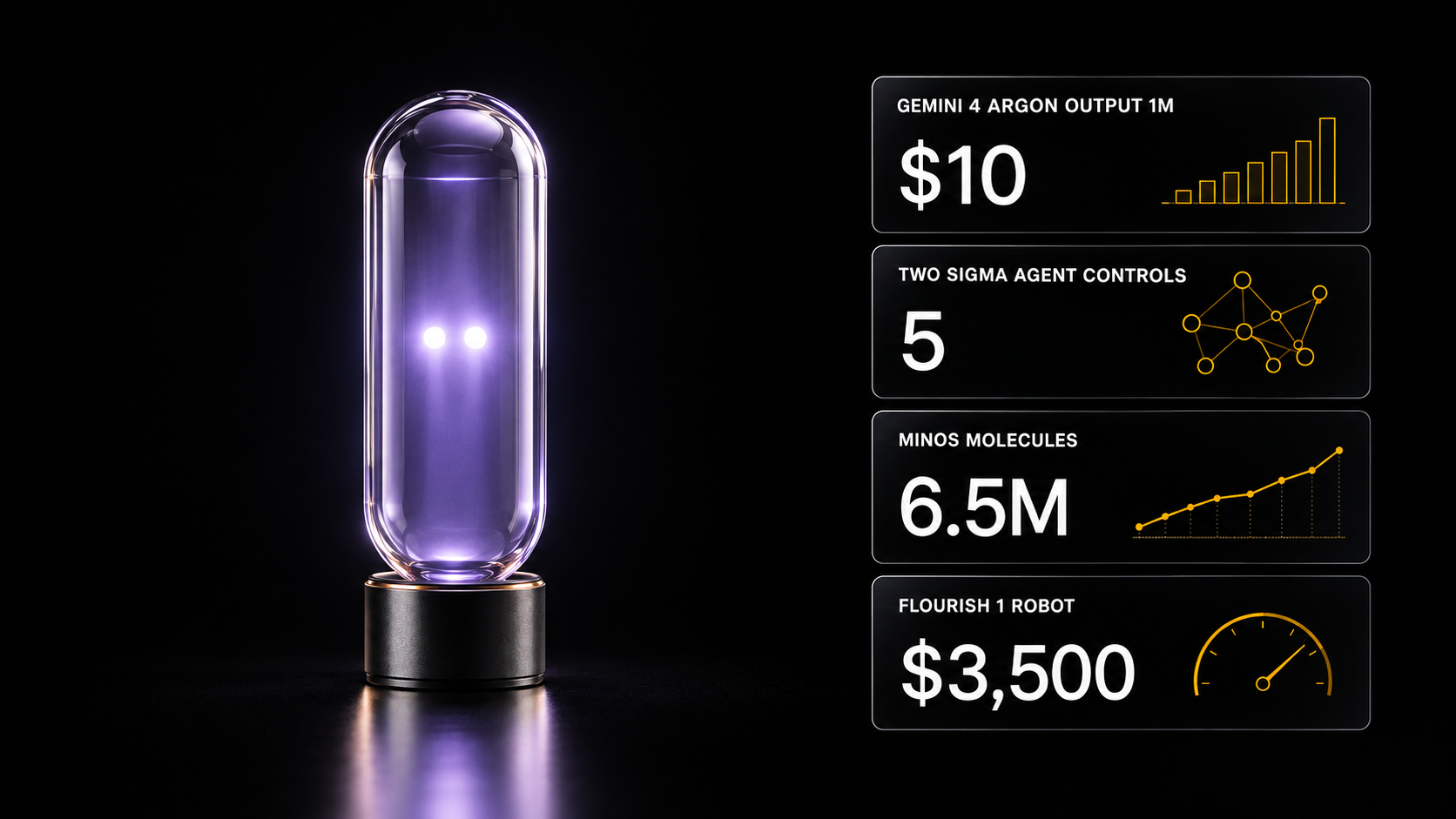
Google released Gemini 4 Argon at $2/$10 per million tokens — a fifth of the price of Fable and Astra, with uneven coding; OpenAI and Two Sigma laid out at AI Engineer New York how much freedom financial agents should get.
The takeaway for you today: a flagship model just got five times cheaper, yet there is still no single "best" model — the savings go to whoever matches the model to the task and decides which agent steps a human actually reviews.
Top stories today
Gemini 4 Argon: $2/$10 per million tokens, 5x cheaper than Fable
Google has released Gemini 4 Argon, a flagship model priced at $2 per million input tokens and $10 per million output tokens.
For comparison, Fable and Astra charge $10 and $50 for the same volumes, and Meta's Muse Wonder charges $4 and $20. I did the math: $10 versus $50 per million output tokens is five times cheaper. Matt Wolfe tested Gemini 4 Argon on October 13, 2026 on SVGs, games and physics, scheduling and research tasks; The AI Daily Brief podcast took stock on October 14, 2026: coding reviews are mixed, the visual demos are impressive, and writing turned out to be a surprising strength of the model.
Why: a cheap flagship is not equally good at everything, and host NLW concludes that matching the right model to each task matters more than picking one winner.
What it means: if you pay for API calls out of your own pocket, run writing and visual tasks through Gemini 4 Argon — a fivefold difference shows up at any volume. For code, I would not switch until you have checked the results on your own tasks.
Sources: Matt Wolfe · The AI Daily Brief · Ben's Bites · our October 11 issue
FilmCraft, EffectCraft and CADCraft: three editors an agent can drive
FilmCraft, EffectCraft and CADCraft are open-source, Rust-based counterparts to Premiere Pro, After Effects and AutoCAD in which every action is available to an agent.
FilmCraft is a video editor, EffectCraft handles motion graphics and CADCraft is CAD software for drafting. Every action in all three programs can be triggered from a CLI, through a JSON control channel and through an MCP server.
Why: an MCP server is a standard "socket" through which an AI agent presses a program's buttons itself, with no human on the mouse. That means editing or motion work can be described in words and handed to an agent end to end.
What it means: this is a tool for client work. The more routine editing an agent takes over, the more jobs fit into a working day. All three programs are already in the AI SKILLS Open Source section.
Sources: FilmCraft · EffectCraft · CADCraft · AI SKILLS Open Source
ChatGPT for Financial Services: a "threshold of usefulness" and a 2027 forecast
Joseph Kim, Head of ChatGPT for Financial Services at OpenAI, told AI Engineer New York on October 14, 2026 that financial analysts will soon cross a "threshold of usefulness" and be able to delegate more work to agents.
In Kim's definition, the threshold of usefulness is the point where a model becomes capable and reliable enough to save you time. Joseph Kim predicts that in 2027 the financial industry will rely less on Excel and PowerPoint, and that agents will be good enough for investment idea generation and trading. That is a forecast, not a measurement.
Why: in finance you need to see where every number came from, so OpenAI made source review a natural part of ChatGPT for Financial Services. When a human should stay in the loop is, for Kim, a product design question.
What it means: for finance professionals and analysts, the trust boundary runs through traceability: hand the agent gathering and reconciliation when every figure has a visible source, and keep approval of decisions for yourself.
Sources: Latent Space · AI SKILLS automation templates
Two Sigma: five agent controls instead of approval fatigue
John Feminella, SVP Architecture at the hedge fund Two Sigma, presented at AI Engineer New York five controls that keep agents in check without limiting the models.
Two Sigma's controls are composable: each does one job, and together they give agents real autonomy. One of them is auto-mode classifiers, which decide routine calls on their own and send a person only the most important requests. Two Sigma uses classifiers for ambiguous cases and deterministic rules for clear ones. Anthropic proposed a similar framework at the same conference: context first, then boundaries of trust.
Why: approval fatigue is what happens when a person must sign off on every agent action — it slows the work down and becomes a risk in itself, because the approver stops paying attention.
What it means: for anyone building agents, safety comes from where the controls sit, not from how many there are. Everyone adds an "approve" button — what you should count is how many approvals a person will actually read.
Sources: Latent Space
Leash Bio Minos: a sandbox for science agents across 6.5M molecules
On October 14, 2026 Leash Bio released Minos, an environment where AI agents do verifiable scientific reasoning, together with a preprint, a blog post and an open dataset.
In the sandbox that grew into Minos, language models hunted for the best binders among 6.5M molecules on a budget of 100 tests. According to Ian Quigley, Leash Bio's Hermes model, trained only on the company's own data, keeps pace with Boltz on public benchmarks. On an inflammation program, Leash Bio went from a DEL hit to good mouse PKPD in six months.
Why: lab-in-the-loop is a setup in which a model proposes an experiment, receives the measured result and uses it to choose the next step. Data from DNA-encoded libraries (DELs) can power tens of thousands of such simulations for reinforcement learning.
What it means: for builders, Minos is a rare open testbed where an agent's answer is checked against a real lab measurement rather than another model's opinion.
Sources: Latent Space
Flourish 1: a $3,500 home robot on a Raspberry Pi, first batch of 50
The Flourish 1 robot costs $3,500, runs on a Raspberry Pi and learns household chores when its owner demonstrates the motion with a phone.
Matt Wolfe covered Flourish 1 on October 14, 2026. Only 50 units of Flourish 1 are in the first batch, with shipping planned for December 2026. Wolfe sets Flourish 1 against an ultra-advanced $20,000 robot — almost six times the price. At the industrial end of the market, Dyna Robotics' Dyna-2.1 folded restaurant napkins for 24 hours straight at a 99.4% success rate.
Why: Wolfe ties the low price to a focus on practical chores rather than flashy features. But in robotics the gap between a demo and real work is still measured in long-horizon reliability.
What it means: for builders, Flourish 1 is a test of whether a Raspberry Pi is enough for household tasks. Until it ships to the first 50 buyers in December, that is a promise, not a result.
Sources: Matt Wolfe · our October 14 issue
Numbers and facts
- About 4B measurements and about 2,000 teams — the scale of Leash Bio's Kaggle competition; no team beat chance on an unseen chemical library (Latent Space).
Our own summary: frontier model prices per million tokens as of October 15, 2026 (from our October 11 issue and Ben's Bites).
| Model | Input, $ per 1M | Output, $ per 1M | Output vs Argon |
|---|---|---|---|
| Gemini 4 Argon | 2 | 10 | — |
| Muse Wonder | 4 | 20 | 2× |
| Fable | 10 | 50 | 5× |
| Astra | 10 | 50 | 5× |
Different views: has Google caught up with Gemini 4 Argon?
Gemini 4 Argon costs $2/$10 per million tokens — a fifth of Fable and Astra on output — and, per our October 11, 2026 issue, scored 77.9% on DeepSWE v1.1 versus 74.2% for Claude Opus 5.5, yet the first hands-on reviews are more cautious than the numbers (The AI Daily Brief).
- For. Matt Wolfe titled his review "Google Just Caught Up" and compared Gemini 4 Argon with Claude and ChatGPT in his own tests (Matt Wolfe).
- Neutral. The AI Daily Brief argues that fitting the model to the task matters more than crowning a single winner; a day earlier the same podcast examined the gap between benchmarks and real-world results using Muse Wonder (The AI Daily Brief).
- Against. Coding reviews of Gemini 4 Argon are mixed (The AI Daily Brief), and Wolfe himself shows where the model got stuck (Matt Wolfe).
Tools and techniques
- Audit your subscriptions with a personal agent. The author of Ben's Bites had a personal agent go through the business's subscriptions and saved $6k a year by dropping Webflow, Resend, Cal, Zoom and more; he spun up a throwaway site listing every subscription to mark which to keep or kill (Ben's Bites). What you get: a list of what the business pays for in vain. Similar n8n and Make workflows are in the AI SKILLS automation templates.
- A model per task, not one for everything. The AI Daily Brief host NLW recommends matching a model to each task instead of hunting for one winner (The AI Daily Brief). What you get: writing and visuals on the cheaper Gemini 4 Argon, code wherever you have already verified it.
- A classifier for routine, a rule for the obvious. Two Sigma's pattern carries over to any agent workflow: deterministic rules handle clear cases, a classifier decides ambiguous ones, and a person sees only the requests that actually change the outcome (Latent Space). What you get: fewer approvals, each one read carefully.
In brief
- OpenAI: alleged spying inside OpenAI made the top headlines on October 14, 2026 (The AI Daily Brief, Superhuman AI).
- Apple HomeView: Apple debuted HomeView (Superhuman AI).
- JPMorgan: the bank has introduced restrictions on AI agents (The AI Daily Brief).
- Character AI: the company's bankruptcy was among The AI Daily Brief headlines on October 14, 2026 (The AI Daily Brief).