Mistral Voxtral 3 TTS at $13 per 1M Characters — AI Digest
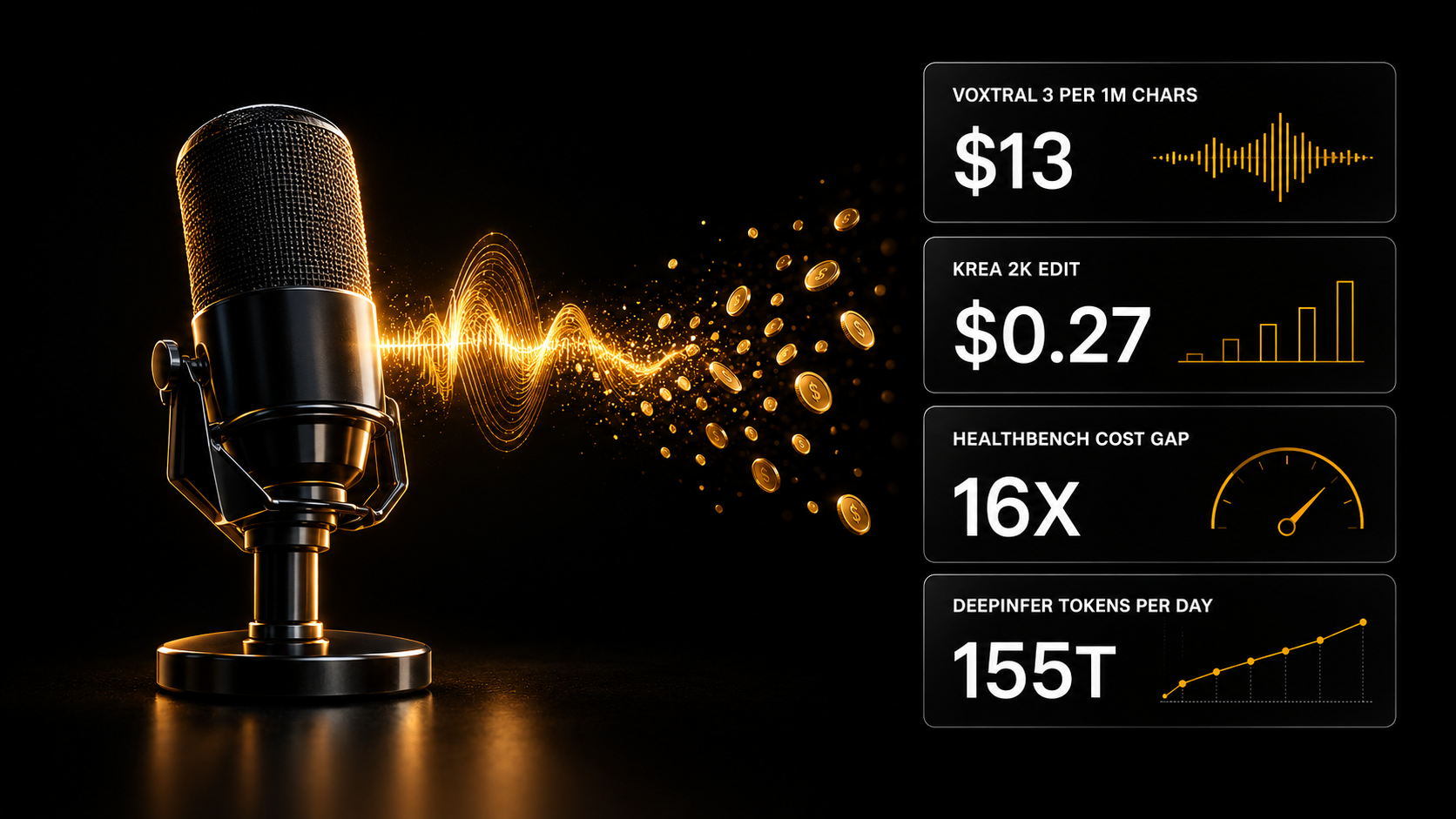
Mistral Voxtral 3 voices a minute of speech for about a cent, Krea edits a 2K image for $0.27, DeepSeek V4.1 Flash nearly matches Sonnet 5.5 on HealthBench at a sixteenth of the cost, and Perplexity Computer now runs locally on a Mac.
The one thing for you today: on October 20, 2026, voice and images fell to cents — a minute of synthetic speech from Mistral costs about a cent, and a 2K image edit from Krea costs 27 cents. What a client pays for now is the script, the selection and the finished delivery, not the generation itself.
Today's main stories
Mistral Voxtral 3: speech synthesis at $13 per million characters — about a cent a minute
Mistral released Voxtral 3 — a set of models for transcription, multilingual text-to-speech and voice agents; speech synthesis costs $13 per million characters, according to Artificial Analysis.
The TTS model produces 112.3 characters per second and entered the top 12 of both voice arenas. Small Transcribe 3 ranked third for transcription accuracy with a 2.1% word error rate. The models run through Mistral's API or on the customer's own infrastructure, and come with a voice-agent SDK that supports tool calling.
Text-to-speech (TTS) is turning written text into a voice. My arithmetic: a minute of speech is roughly 1,000 characters, so $13 / 1,000,000 × 1,000 ≈ $0.013 per minute of voiceover.
What it means: client work. At about a cent a minute, the voice is no longer the expensive part of a short video — the value sits in the script, pacing and the final mix with sound, which is what a client actually pays for.
Sources: Mistral · Guillaume Lample · Artificial Analysis · speed measurement · AI prompt generator
Krea 3 Ultra and Bria Fibo 2.0: a 2K image edit for $0.27, a generated image for 3 cents
Krea released Krea 3 Ultra, where a 2K edit with one reference image costs $0.27; Bria opened the 8-billion-parameter Fibo 2.0 family with API pricing of $32 per 1,000 images.
$32 / 1,000 = $0.032 per image for Fibo 2.0. Krea 3 Ultra outputs 2K only; the Fast tier costs $0.03 per 1K output image plus $0.02 per 1K reference image. Artificial Analysis rates Fibo 2.0 the leading open-weight editing model and places Krea 3 Ultra fifth, while Arena ranks it fourth in multi-image editing.
Open weights are a model you can download and run yourself. Fibo 2.0 weights are non-commercial: selling work made with them requires a separate agreement with Bria.
What it means: client work. A finished edit now costs well under a dollar to produce, so the margin lies in selection and polish. For paid client jobs, use Bria's API rather than the downloaded weights.
Sources: Artificial Analysis on Fibo 2.0 · Artificial Analysis on Krea 3 · Arena · AI prompt generator for images
HealthBench: DeepSeek V4.1 Flash answers medical questions 16 times cheaper than Sonnet 5.5
Artificial Analysis launched HealthBench leaderboards — 5,000 general health conversations and 525 clinician conversations; DeepSeek V4.1 Flash scored 60.9% at $0.005 per task, Claude Sonnet 5.5 scored 62.1% at $0.08.
$0.08 / $0.005 = 16: a 1.2-point quality gap for a 16-fold price difference. On the professional set, GPT-6 Astra leads with 66.0% after length adjustment. Opus 5.5 had the highest raw score at 71.4% but dropped to 59.9% once length was taken into account.
Length adjustment is a rescoring step that stops a model from winning on answer length alone. Answers are graded by OpenAI models, following the original benchmark.
What it means: profession and trust. To a doctor or a clinic, a long model answer looks thorough, yet in this ranking it loses up to 11.5 points. The decision about a patient stays with the doctor.
Sources: Artificial Analysis · AI in medicine: what you can and cannot delegate
Perplexity Computer: the agent now runs entirely on a Mac, offline and without credits
Perplexity brought Perplexity Computer to Apple-silicon Macs: both the model and the agent run locally, including offline, and work with native apps and files on disk.
Local tasks run on PPLX Pro, a post-trained version of Qwen 3.8, and do not consume Computer credits. The mode is available to Pro, Max and Enterprise subscribers, with 36 GB of unified memory recommended. A separate hybrid mode splits the work between local and cloud models.
Running locally means the model works on your own machine, so documents never reach someone else's servers. In hybrid mode that promise no longer fully holds — part of the data goes to the cloud.
What it means: business. A law office or clinic that cannot send documents to an outside service should use only the fully local mode: a Mac with 36 GB of memory and a Pro subscription, with no per-task charges.
Sources: Perplexity · model · requirements · Open Source on AI SKILLS
DeepSeek DeepInfer: the open engine serving 155 trillion tokens a day
DeepSeek open-sourced DeepInfer, the engine behind DeepSeek V4.1 Flash; according to the company's report, one cluster serves 155 trillion tokens a day with a 96% input-cache hit rate and earns $38 of revenue per accelerator-hour at off-peak prices.
The first token arrives in 400 ms on average, generation runs at 230 tokens per second and up to 300 for code. The prompt cache sits in a separate 100 PiB cluster: three days for agent traffic, seven days for chat. The vLLM team matched decode throughput in the same GB200 configuration to within 6%.
A prompt cache stores the start of a request: an agent resends the same history, and the model does not recompute it. That is why the 155 trillion figure is mostly cached repeats, not newly generated tokens.
What it means: for builders. Cache management and load balancing are not open yet, so the whole service cannot be reproduced, but vLLM has already published recipes that match its decode speed.
Sources: DeepSeek · technical write-up · vLLM · GitHub · LLM API pricing guide
Vals Router Index: all five routers lost to standalone models on both score and cost
Vals tested five routers — services that pick a model for each request — on 1,250 tasks; every one was beaten by at least one standalone model on both score and cost.
Picking the best model per task in hindsight within the same budget would add 8–27 points, so routing has headroom that today's routers do not capture. A narrow task looks different: on ClaimBench, a financial-document classification test, Decider V1.2 handled 99.7% of claims itself and escalated the rest to Haiku 5.5 — 99.9% accuracy at $0.11 per 1,000 claims versus $1.19 for Haiku alone.
$1.19 / $0.11 ≈ 10.8 times cheaper.
What it means: business. For an accounting team or insurer processing a stream of similar documents, a cascade of a cheap model plus a strong one for hard cases costs a tenth as much. For mixed workloads, one good model still beats a router.
Sources: Vals Router Index · oracle comparison · ClaimBench · cascade · automation templates
PyTorch 2.15 on Mac: MoE models decode 5–6.5 times faster
PyTorch 2.15 replaced several MPSGraph paths with Metal kernels: MoE decoding on Apple silicon is 5–6.5 times faster, and Qwen3.6-35B-A3B on an M3 Ultra went from 9.4 to 61.3 tokens per second.
FP8 is now supported on MPS, and peak driver memory for the Wan2.2 VAE fell from about 270 GiB to 8 GiB. The gains ship in PyTorch itself rather than in a separate inference runtime.
A mixture-of-experts (MoE) model runs only part of its parameters for each request: Qwen3.6-35B-A3B activates about 3 billion of its 35 billion.
What it means: for builders. On an M3 Ultra, an open MoE model now answers fast enough for real chat work — 61 tokens per second instead of 9.
Sources: LysandreJik · open-source LLM guide
Numbers and facts
Our own summary: what voice and images cost as of October 20, 2026.
| Task | Model | Price | Per job |
|---|---|---|---|
| Voiceover | Mistral Voxtral 3 | $13 per 1M characters | ≈ $0.013 per minute of speech |
| Text-to-image | Bria Fibo 2.0 (API) | $32 per 1,000 images | $0.032 per image |
| 2K image edit | Krea 3 Ultra | $0.27 with one reference | $0.27 per edit |
| Medical answer | DeepSeek V4.1 Flash | $0.005 per task | 60.9% on HealthBench |
- $0.20 — median cost per task for DeepSeek V4.1 Flash 20261017 Max in Agent Arena; it ranks first among open models and 11th overall across 7,500+ real sessions (Arena).
- About 1,000 tokens per second per user on GB300 NVL72 with SGLang's new megakernel support, per SemiAnalysis (SemiAnalysis).
- From 178.8 to 64.6 seconds — Zyphra's cut to GLM-5.3 time-to-first-token at 512K context on AMD MI355X (Zyphra).
- 1.9 million parameters in Kyutai's smallest Pocket TTS, which the developers say runs 103 times faster than real time on one CPU core (Kyutai).
- 6.4% higher on average — labs' self-reported benchmark scores versus independent testers across 611 matched comparisons of 180 models (r/LocalLLaMA).
Different views: does DeepSeek really make 80% on every model answer?
DeepSeek disclosed $38 of revenue per accelerator-hour at off-peak prices but named neither the GPU nor its cost; margin estimates of 74% to 96% depend on the assumed rental price and leave out the SSD cache fleet, CPUs, networking and idle capacity.
- For. The author of the most-shared estimate, after correcting for the reported $38 an hour instead of an ideal $49, put the margin at 84.2–96.1% (zephyr_z9).
- Neutral. Yuchen Jin gets about 81.6% at $7 an hour but stresses that DeepSeek never said which hardware produced that revenue (Yuchenj_UW); at $5–10 an hour the range is 73.7–86.8% (swyx).
- Against. Skeptics point out that token prices keep falling while compute gets more expensive, which should compress these returns over time (teortaxesTex).
Tools and techniques
- Do not give an agent access to your email and drive without approving each action. Dots users warn that an agent connected to Gmail and Google Drive can follow instructions planted in someone else's email or attachment (r/ChatGPT). Prompt injection is a hidden command in text the agent reads as its own task (OWASP). What you get: the agent reads and drafts, but sends and deletes only after your "yes".
- Give AI the checking of your calculations, not the calculations themselves. Physicist E. O. Kahya split an audit of his earlier quantum-gravity work into 18 tasks across 9 stages; Claude ran the algebra through SymPy and mpmath, found a sign error, a missing term and 23 typos, and the paper's main result still held (GitHub, r/singularity). What you get: a lawyer, analyst or engineer checks a long document in an evening instead of a week.
- Turn on OpenAI's 12-hour prompt caching for long-running agents. It can be mixed with the default 30-minute cache in one request; longer retention costs more but pays off when an agent returns to the same context hours later (OpenAIDevs, configuration). What you get: an agent left running over lunch does not recompute its whole history.
In brief
- OpenAI usage limits: the company found about 40,000 accounts whose applied limits did not match their plan, fixed the issue and promised credits (thsottiaux).
- Scorpion-toxin binders: Anthropic and Citrini got 17 binders out of 211 tested protein designs; none were tested for neutralization, so this is not an antivenom (AnthropicAI, caveat).
- Opus 5.5 beat Baldur's Gate 3: the model finished the game on its own in 39 hours, for $712 and 20,809 tool calls (r/ClaudeCode, author's write-up).
- Arda: former OpenAI research chief Bob McGrew launched manufacturing software with a $160M Series A at a $1.5B valuation (bobmcgrewai).
- Orchestra Bio: OpenAI is acquiring the drug-development coordination platform; terms were not disclosed (OpenAI).
- Holon-S1: Sophont's model predicts spatial gene activity from routine pathology slides, evaluated across 16 organ types and more than 15 scanners (iScienceLuvr).
- AI-written research papers: GPT-6 Astra and Claude Fable 5.1 each got a $10,000 budget, but the original paper authors rejected both resulting papers (sayashk).
- Anthropic's prospectus: according to a WSJ report, first-half revenue was $16.3B and compute spending nearly $9B (kimmonismus).