MemoryTax: Agent Memory at Half the Cost — AI Digest
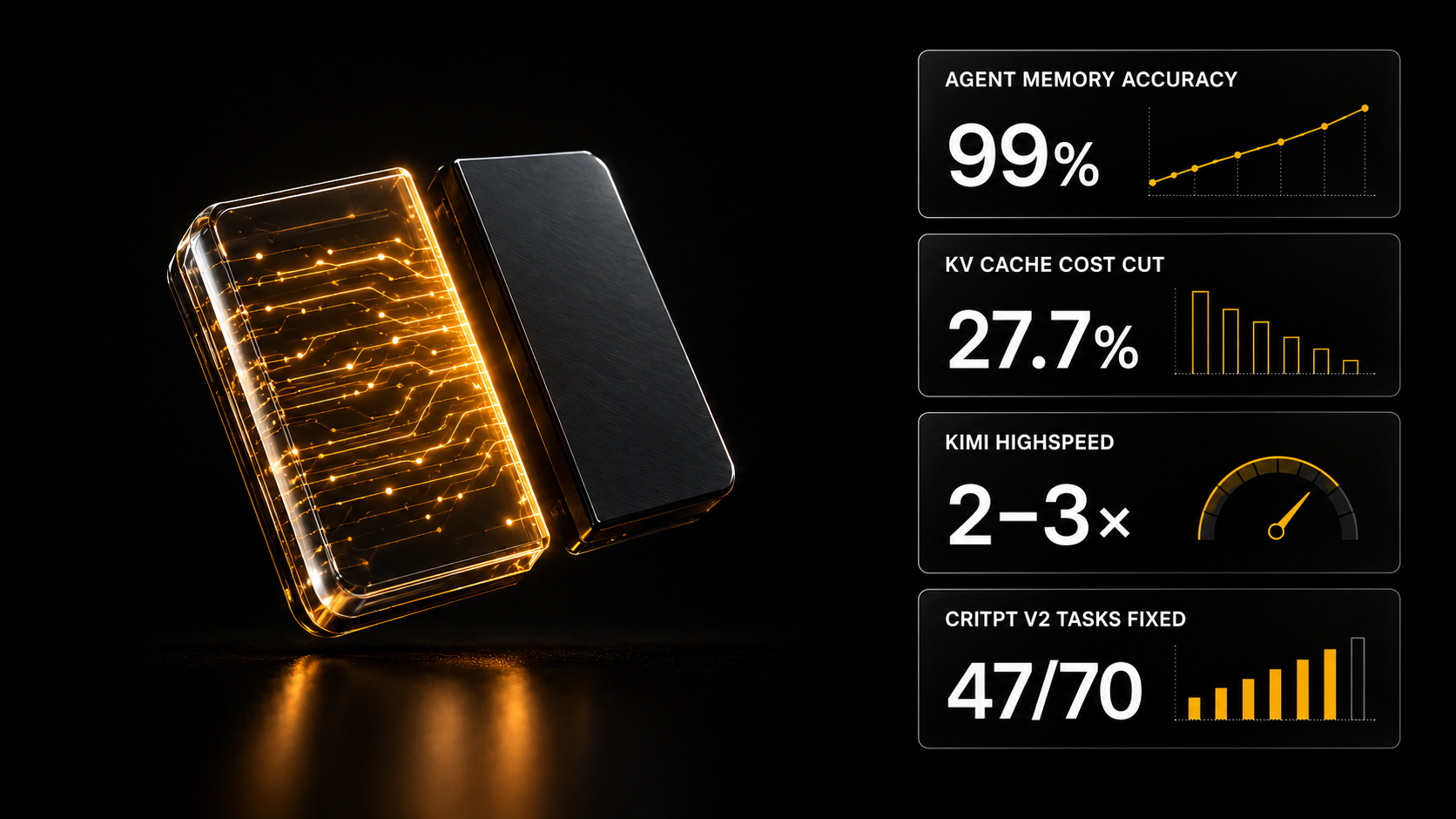
MemoryTax: Opus 5.5 with history search answers correctly 99% of the time at half the cost of full context. Also: Kimi Hosted Agents run around the clock, Dioramas 3D websites and a skill for tracing ancestors in former Soviet archives.
Today's main point for you: keeping a long client conversation in an agent's memory just got cheaper. In the MemoryTax test, a strong model that searches the raw history answered correctly 99% of the time at less than half the cost of feeding it the whole conversation. If you build assistants for teams, a separate memory service now has to earn its place in the budget instead of being added by default.
Today's top stories
MemoryTax: Opus 5.5 recalls a conversation at 99% for half the cost of full context
The MemoryTax study found that on a 419-turn conversation, the Pi agent running Opus 5.5 and searching the raw history answered correctly 99% of the time at less than half the cost of using the full context.
The Mem0 memory service helped only weak models in the same test. Toloka and xmemory, on the other hand, report memory gains across 11 models, so the answer depends on the model and on how the history is stored. MemoryTax measured a single conversation: treat it as a signal, not a law.
Context is everything a model keeps in view within one request, and every token of it is paid for again at every step. Searching the history pulls in only the pieces that matter, which keeps the bill smaller.
What it means: client work. In a team assistant with long conversations, context is the main running cost. In my view, a strong model does fine with history search and no separate memory service, which is one subscription fewer in the client's estimate.
Sources: MemoryTax · Toloka and xmemory · AI SKILLS agent templates
Kimi Hosted Agents: an agent that runs 24/7, and Highspeed answers 2–3 times faster
Alongside Kimi K3.1 Pro, Moonshot launched Kimi Hosted Agents on October 23, 2026: a managed harness with an always-on execution environment for long-running work and multi-agent collaboration.
Standard and Highspeed versions are available on the Kimi website and app, in Kimi Work, in Kimi Code and through the API. Moonshot says Highspeed generates output 2–3 times faster without losing quality, but costs twice as much. Standard pricing is $2 per million input tokens and $10 per million output tokens.
A harness is the scaffolding around a model: tools, memory and an execution environment. If the model is the chef, the harness is the kitchen, and Kimi Hosted Agents keeps that kitchen on Moonshot's side, so you do not need your own server for the agent.
What it means: business. A shop or a salon that wanted an agent sorting requests around the clock used to need its own server and someone to watch it. I would start with Standard: the doubled Highspeed price pays off where a customer is waiting for a chat reply.
Sources: Moonshot · pricing · Artificial Analysis
Dioramas: 20 ready-made 3D websites with models and textures made by AI
Dioramas is a free open-source framework for cinematic, interactive 3D websites in which AI generates the models and textures from text descriptions.
Three.js handles the scenes and cameras. Meshy 7.1 and Nano Banana 2 produce the 3D models and textures through the fal.ai service, so generation is paid to that service. The package ships with 20 example websites. The code is written in JavaScript.
Three.js is a library that renders a three-dimensional scene right in the browser, without plugins. Dioramas connects it to 3D generators, so a text description turns into an object on the page.
What it means: client work. A live 3D scene instead of a stock image is a clear reason to quote the top of your landing-page range. The twenty examples are portfolio starters: I would begin with one tailored to a future client's niche.
Sources: Dioramas on GitHub · Open Source on AI SKILLS
ex-ussr-kinship-research: a skill that traces ancestors in the archives of 15 former Soviet states
ex-ussr-kinship-research is an open skill for AI agents that collects the main archival sources of 15 former Soviet states, plus the rules for working with them, to rebuild a family tree.
The skill covers archives in Russia, Ukraine, Belarus, Moldova, Estonia, Latvia, Lithuania, Georgia, Armenia, Azerbaijan, Kazakhstan, Kyrgyzstan, Tajikistan, Turkmenistan and Uzbekistan. If a family has real ties to Poland, Finland, Romania, Germany and Prussia, Austria-Hungary or the Ottoman Empire, those lands are added too. The author accepts improvements through pull requests.
A skill is a file of instructions and techniques that an agent loads for a specific task. Here it tells the agent where to search and how to read archival records.
What it means: profession and trust. For genealogists and archivists, the agent shortens the search for sources. The boundary is the conclusions: in my view, every "father to son" link drawn from the records should be confirmed by a person before it goes into a client's family tree.
Sources: repository · Claude Code skills guide
AKV: the agent prunes its own KV cache and cuts cost by 27.7%
The AKV method lets an agent drop and reposition parts of its own KV cache; according to the authors, this lowers cost by 27.7% and adds 1.7 accuracy points.
A KV cache is the model's memory of the text it has already read: everything in it occupies GPU memory and costs money at every step. Normally the cache only grows; with AKV the agent decides what it no longer needs.
AMPD (ICML 2026) appeared alongside it: it routes context re-reading in multi-turn agent sessions between dedicated prefill workers and the session's own worker, based on latency headroom. The authors report a 67% average relative improvement in meeting latency targets compared with Dynamo, which is not a 1.67x speedup.
What it means: for builders. Long agent sessions get expensive because the context keeps growing; AKV and AMPD attack that cost from two sides, the model and the server.
CritPt v2: 47 of 70 tasks corrected, GPT-6 Astra scores 83%
The authors of the CritPt physics benchmark released a second version that corrects 47 of its 70 tasks, partly based on bug reports from Anthropic and Hugging Face.
Run agentically with code tools, Artificial Analysis measured GPT-6 Astra at 83%, GPT-6.1 Sol at 82% and Opus 5.5 at 78%. The gap between the top two is one point, not worth switching for.
A benchmark is a set of tasks with known answers used to compare models. If two thirds of the tasks had to be fixed, earlier scores partly measured errors in the tasks themselves.
FrontierCS 2 follows the same push for rigor: the papers' contributions are removed from the released code, and an agent must beat the original method without seeing the paper.
What it means: for builders. Do not compare old CritPt scores with new ones; when you pick a model for scientific calculations, look at v2.
Sources: CritPt v2 · Artificial Analysis · FrontierCS 2
Modal Spindle: fine-tuning billed by GPU time instead of tokens
Modal released Spindle, an open-source fine-tuning server compatible with the Tinker interface, where you pay for GPU time rather than for the number of tokens.
Tinker compatibility means the server accepts the same way of calling it as that fine-tuning service. Separately, Modular made the source code of its MAX platform available.
Fine-tuning means training an existing model further on your own examples so it handles a narrow task better. With per-token billing, long examples cost more in proportion to their size; with per-time billing, idle time and slow code are what cost the most.
What it means: for builders. Which scheme is cheaper depends on your data: long documents favor paying for time, short exchanges favor paying for tokens. Run the numbers on your own dataset, not on the price list.
Numbers and facts
Our summary: Kimi K3.1 Pro in two modes next to the competitor prices quoted at launch, per million tokens.
| Model | Input | Output | Versus Kimi K3.1 Pro Standard |
|---|---|---|---|
| Kimi K3.1 Pro Standard | $2 | $10 | — |
| Kimi K3.1 Pro Highspeed | ≈$4 | ≈$20 | 2x more |
| Opus 5.5 | $4 | $20 | 2x more |
| GPT-6 Astra | $10 | $50 | 5x more |
Standard prices from Artificial Analysis; "twice the price" for Highspeed from Moonshot's summary; Opus 5.5 and GPT-6 Astra prices from the launch comparison. I calculated the Highspeed figures and the multiplier column.
- From 90.5% to 81%: Kimi K3.1 Pro's internal cyberattack score dropped after Moonshot removed cybersecurity data from mid-training and reinforcement learning (report breakdown).
- 71% smaller: Recursive says its Eureka Machine cut model size by 71% with almost no quality loss, and the whole model was developed from scratch in under four months (Richard Socher).
- $100,000 is the prize for making Muse Spark run fastest; GPU_MODE alleges the organizers rewrote its open-source code without credit and shipped a closed binary (Daniel Gross, GPU_MODE).
- 4 billion parameters: Perplexity's decider model runs locally on a Mac (Denis Yarats).
Different views: will the AI boom pay off, and what will Anthropic's IPO show?
On October 26, 2026, Anthropic filed a Form S-1 with the U.S. Securities and Exchange Commission. It plans to list its Class A common stock on the Nasdaq Global Select Market under the symbol ANT; the number of shares and the price range have not been set, and Goldman Sachs and Morgan Stanley are handling the prospectus. A Form S-1 is the prospectus in which a company discloses its finances before going public, so the market will see the economics of a large AI lab in numbers for the first time.
- For. In its DeepInfer release, DeepSeek disclosed $38 of revenue per accelerator per hour at off-peak prices, which suggests inference makes money on its own; we covered it in detail in the October 22 issue (DeepInfer).
- Neutral. SemiAnalysis left DeepInfer out of its InferenceX benchmark because essential serving components are missing and rebuilding them would require too many assumptions. Critics faulted its own profitability comparison for mixing hardware generations, peak and off-peak prices, and revenue with profit (SemiAnalysis, critique).
- Against. On October 26, 2026, The AI Daily Brief framed the week around four questions: is China closing the gap, is cyber chaos the new normal, is data center funding drying up, and what happens if Anthropic's IPO disappoints. It also discussed Elon Musk's warning about the debt market (Anthropic, Form S-1, The AI Daily Brief).
Tools and techniques
- Fix a TV with an agent. A Claude user had it sort out a Samsung TV: the agent identified Tizen rather than Android, served a local web page, generated a QR code and watched the screen through the phone camera, taking a picture every 4 seconds (r/ClaudeAI). What you get: an agent that sees the result of its actions even where it has no direct access to the device.
- Strip a TV's ad-heavy shell with a ready-made project. In the same discussion, commenters recommend cleanyourtv, an open-source project with roughly 15,000 GitHub stars for debloating smart TVs (cleanyourtv). What you get: the same result without spending tokens.
- Track world news on one map. The author of CLSTR gave Claude Code a database of 11,079,667 articles: the system processes about 100,000 articles a day from 40,000+ sources in 40 languages and clusters them into events by country (r/ClaudeCode). What you get: a model for building news analytics around a client's industry.
In brief
- Adam Schiff: the U.S. senator called for mandatory, industry-wide AI guardrails (post).
- Google DeepMind: Seán Ó hÉigeartaigh described perpetual non-disparagement terms that, in his account, discourage staff from objecting to weapons and surveillance uses (thread).
- Kimi K3.1 Pro: Moonshot showed a website with a 3D robotic hand that breaks apart into 2,317 pieces (demo).