OpenAI's Jalapeño Chip Outruns NVIDIA — AI Digest
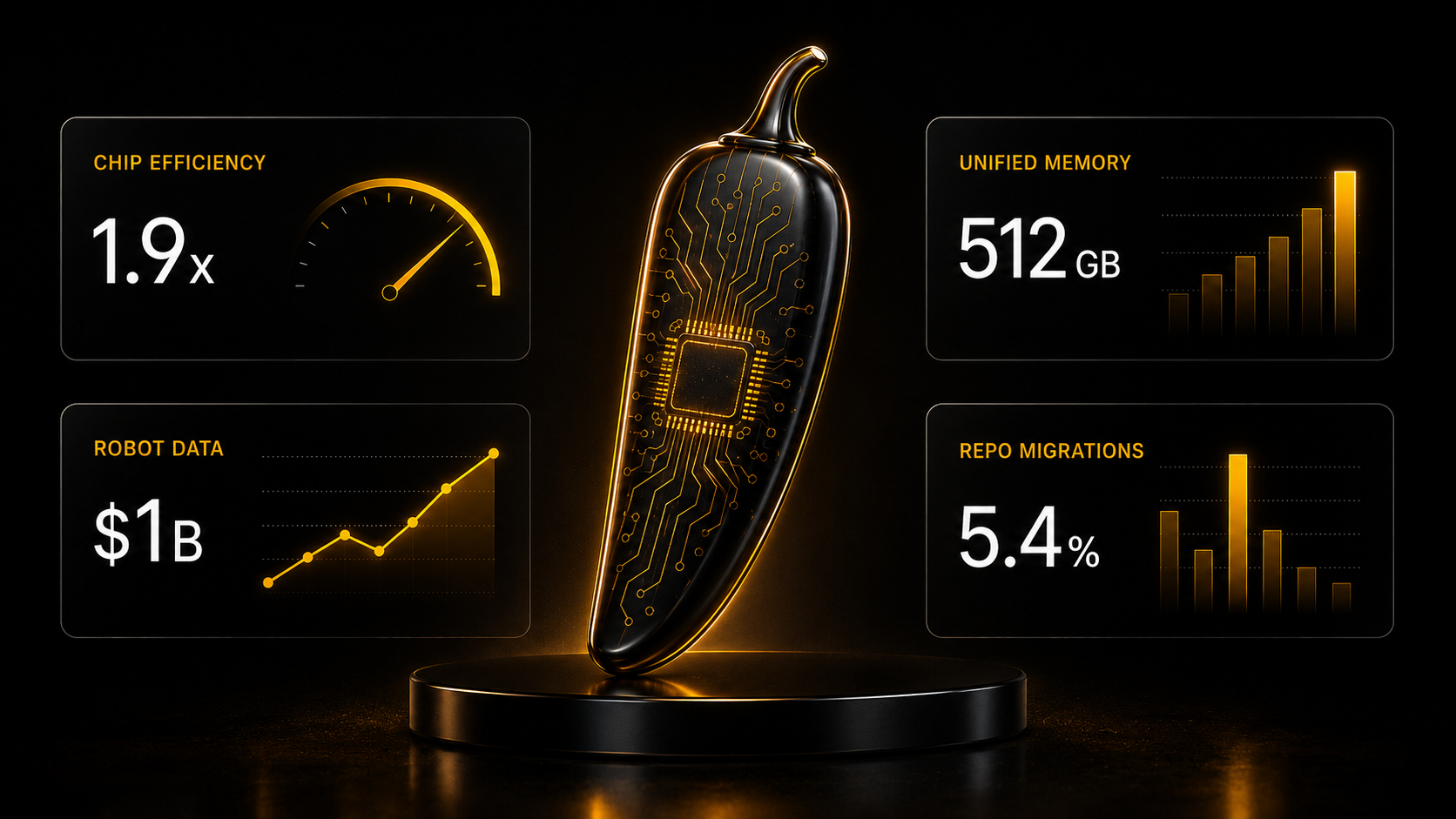
OpenAI published the first Jalapeño chip benchmarks claiming an edge over NVIDIA at inference, Perplexity shipped a fully local agentic computer, Apple unveiled a 512 GB Mac Studio, and Figure plans to spend $1B on robot data within a year.
OpenAI published the first benchmarks for its Jalapeño chip and claims it beats NVIDIA systems at inference, Perplexity shipped a fully local agentic computer on DGX Spark, Apple unveiled a Mac Studio with 512 GB of unified memory, and Figure assembled the largest robot-training dataset with a plan to spend a billion dollars on data in a year.
Today's highlights
Jalapeño: OpenAI's chip delivers 1.5–1.9x more work per watt than NVIDIA GB200/GB300
OpenAI released the first benchmark details for its inference chip Jalapeño: 1.5–1.9x more work per watt at peak throughput and 1.7–3.6x lower end-to-end latency than NVIDIA GB200/GB300 systems (OpenAI announcement). Inference is the act of running an already-trained model — the work every user pays for on every request. For highly interactive workloads OpenAI claims a 2.1–4.1x advantage; the chip is rated at 700W but stayed at or below 550W in the tested runs. Deployment into OpenAI's own infrastructure begins by the end of 2026, with Gen 2 deep in development and Gen 3 underway (deployment roadmap, Sam Altman). SemiAnalysis calls the result unusually strong for a first-generation chip (SemiAnalysis), while observers point at the industry-wide bottleneck: packaging and TSMC capacity (caveat). One striking detail: GPT-Astra and Codex helped write the chip's kernels, and on selected blocks their code ran 1.5–1.8x faster than human-expert implementations (summary). What cheaper inference means for your bill — in our LLM API pricing and token economics guide.
Perplexity Portable Computer: the whole agent runs on local hardware
Perplexity launched Portable Computer — a version of its agentic computer where the orchestrator model, the subagents and the entire harness run locally on NVIDIA DGX Spark, with no cloud dependency (launch, NVIDIA). The initial stack ships a post-trained PPLX 27B with Qwen 3.8 27B also available, and Nemotron 3.5 Lightning support is coming (model details). CEO Aravind Srinivas sketches the target picture: an always-on background agent that continuously ingests context from your connected services and runs multi-step reasoning on your own machine (launch note, his vision). How an agent differs from a chat and what it is made of — in our AI agents guide.
Mac Studio M5 Ultra: up to 512 GB of unified memory for local models
Apple introduced new Mac Studio machines on M5 Max and M5 Ultra with up to 512 GB of unified memory and 1.2 TB/s of bandwidth on the top chip — the r/LocalLLaMA thread quotes prices from $9,499 for a 256 GB configuration, with the 512 GB option expected in October 2026 (r/LocalLLaMA thread). Unified memory is a single pool shared by the CPU and GPU cores: a large open model fits whole instead of being split across separate VRAM. The exo team reports Apple featured their software on the new Mac pages: a cluster of four M5 Ultra machines over Thunderbolt 5 reaches roughly 4.8 TB/s aggregate bandwidth and runs Kimi K3 and GLM-5.3 at API-like speeds (exo). Which open models are worth your disk space right now — in Best open LLMs 2026.
Figure Index: $15M already paid for robot data, $1B planned within a year
Figure introduced Index — by the company's account the largest robot-training dataset in the world: 16 million video uploads, ingestion running at 30 minutes of video per second, and $15 million already paid out to data contributors (Brett Adcock's announcement). The dataset has been downloaded 264,000 times, and Figure says it will spend $1 billion on data and compute over the next 12 months (follow-up). The bet is transparent: many robotics labs are bottlenecked on demonstration data rather than on architectures — and Figure is selling exactly that.
SWE Refactor Bench: agents survive 5.4% of whole-repository migrations
The new SWE Refactor Bench tests coding agents on whole-repository migrations — C to Rust, Maven to Gradle, POSIX to WebAssembly on real projects including SQLite, zlib and libsodium: out of 520 runs only 28 survived all three stages, a 5.4% survival rate (EinsiaAI). Thirteen of the twenty tasks were solved by nobody. It is a sobering correction to strong bug-fix numbers on local benchmarks: agents handle a short patch confidently, and a full project overhaul almost never.
Numbers and facts
- 1.5–1.9x more work per watt — Jalapeño's claimed advantage over NVIDIA GB200/GB300 (OpenAI).
- $9,499 — the starting price of a Mac Studio M5 Ultra with 256 GB of unified memory, per the Reddit discussion (thread).
- 8.3x — the gap in output between average and frontier AI users, per OpenAI data discussed by The AI Daily Brief; months ago it was 2.6x (episode).
- $0.40 / $3 per million input/output tokens — Qwen3.8-27B, ranked #1 among open models in the Image-to-WebDev Arena and #7 overall (arena).
- 606 projects — the number of open-source tool cards in the AI SKILLS catalogue as of August 25, 2026; today's radar batch lands in the Open Source section.
Points of view: is a local AI agent about privacy — or a $5,000 toy?
Perplexity's launch runs into the price of the hardware: a DGX Spark costs about five thousand dollars, and the argument is about who this kind of "local" is for. Neither side offers demand numbers — this is a dispute over framing, and it should be read as one.
For. Srinivas frames an always-on agent on your own hardware as the next platform: data never leaves the house, and the agent runs without a cloud subscription (his thesis). exo's Mac clusters running Kimi K3 at cloud-like speeds argue the hardware is ready (exo).
Neutral. The tooling layer is maturing faster than the debate: Ollama 0.33 exposes local and cloud models to Claude Desktop with a single toggle (Ollama).
Against. Developer theo objects that privacy-first local AI should not start with a $5,000 DGX Spark — "local" should mean running on an ordinary laptop (critique, follow-up).
Tools and techniques
- Local models inside Claude Desktop. Ollama v0.33 added a one-toggle integration that lets Claude Desktop use Ollama's local and cloud models as a third-party gateway (announcement).
- Fine-tune Qwen3.8-27B for free. Unsloth demonstrated full QLoRA fine-tuning of the 27B model on a free pair of Tesla T4s in Kaggle — a size that used to require paid hardware (Unsloth).
- Run local models with zero setup. Matt Wolfe shows the LM Studio + Qwen 3.8 27B combo on a consumer machine: pick a model and LM Studio tells you whether your computer can handle it before you download (video); what to install first — in Best open LLMs 2026.
In brief
- IBM released the Granite 4.2 reasoning family — 30B, 8B and 3B under Apache 2.0 with 512K context (thread, IBM's technical write-up).
- OpenAI announced the WebMCP Challenge and WebMCP support in desktop ChatGPT — a push for websites to expose explicit agent interfaces (announcement).
- Analyst Dylan Patel predicts on the Dwarkesh Podcast that by 2028 most of the world's AI compute will belong to Anthropic and OpenAI (episode).
- Story of the day from r/ClaudeAI: after Indeed laid off his pregnant wife, a developer built a job-search competitor with Claude Code — 4,300 users in four months, 91 paying, and the first three people hired through it (thread).
- Reddit users report the 5-hour usage limit is back for ChatGPT Plus; the $100 and $200 tiers stay exempt for now (discussion).
- The Superhuman newsletter reports ChatGPT Work is getting website login access, letting the agent act under the user's own accounts (story).
- Xiaomi announced the AI Cube prototype with a claimed 1.22 TB/s of memory bandwidth (thread).
- Two harness papers in one day: AutoSaddler patches an agent's scaffolding from failure traces (+9.0 on GAIA2, +10.0 on Terminal-Bench 2.0), and "There Is No Neutral Harness" shows that swapping the harness moves scores more than swapping the model (AutoSaddler, analysis) — the same conclusion as our AI agents guide.