Learning Midjourney: where to start and where everybody stalls
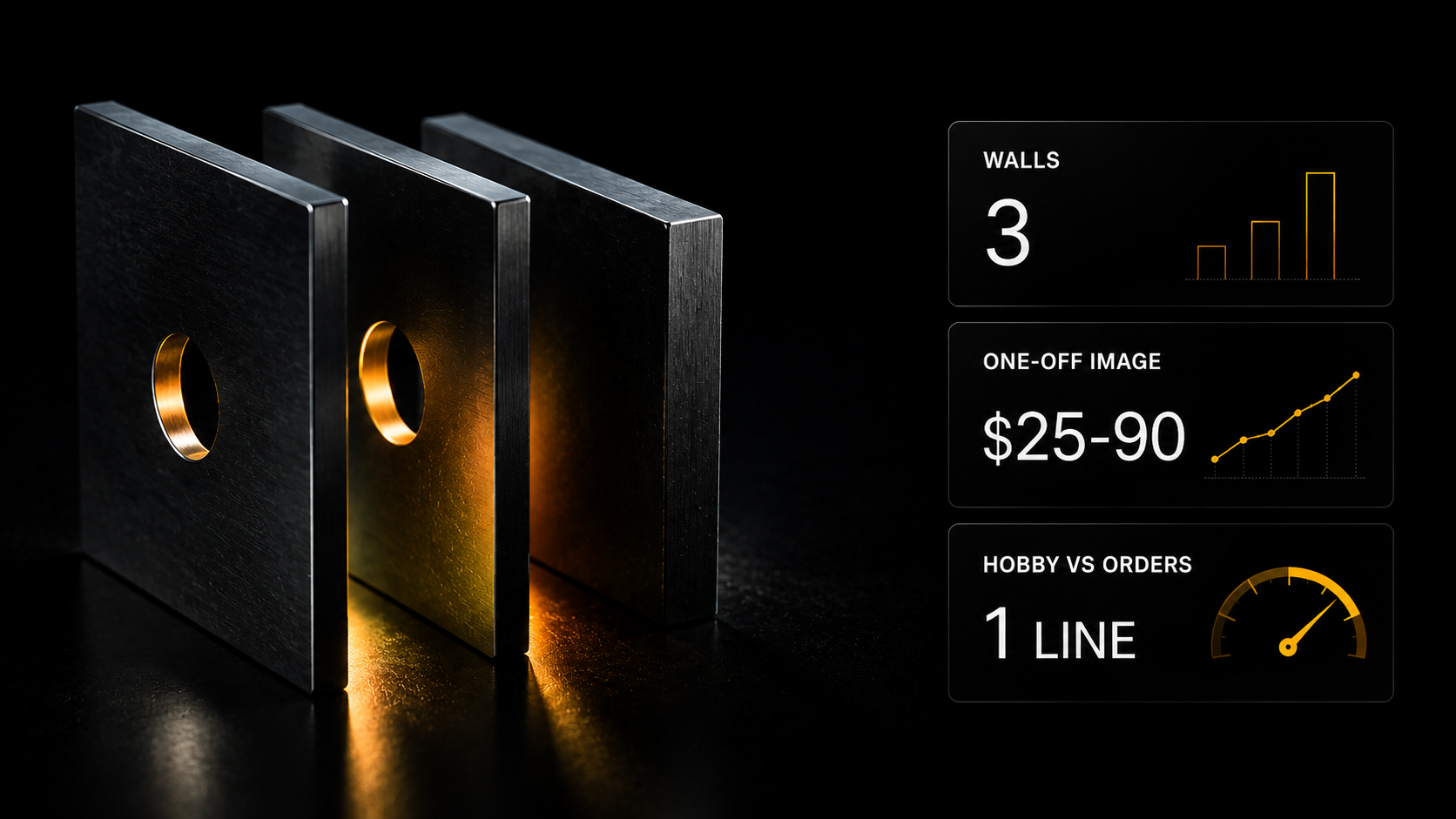
The first impression is wow; the second, a week later, is that getting what you actually need is impossible. At the first stage you are not directing, you are receiving gifts — and a gift cannot be delivered to a client. Below are the three walls people hit and what separates a hobby from paid work.
The first impression is wow; the second, a week later, is that getting what you actually need is impossible. At the first stage you are not directing, you are receiving gifts — and a gift cannot be delivered to a client. Below are the three walls people hit and what separates a hobby from paid work.
---
It comes out beautiful and it is not what you needed
Almost everybody's first impression of Midjourney is the same: wow. You type a few words and get a picture that looks like an illustrator's work.
The second impression arrives a week later and sounds different: getting the result you need is impossible. Beautiful, yes. What was required, no.
You ask for a logo for a coffee shop and get an abstract composition with coffee. You ask for the same character in a different pose and get a different person. You ask for a vertical frame for stories and get a square.
The problem is that at the first stage you are not directing, you are receiving gifts. A gift cannot be delivered to a client: a client needs a specific result in a specific format.
The difference between "I can generate" and "I can get what is needed" is the whole path.
Three walls people hit
Wall one: getting in
The service has a high technical barrier. Signing up and paying is a separate quest.
Most people fall away here without seeing a single image. That is a purely technical task and it gets solved — but it has to be solved before the actual work starts.
Wall two: the interface and the commands
The work does not happen in a familiar window with fields. There is a set of commands and parameters, and without them you use a fraction of what is available.
What genuinely changes the result: the aspect ratio, how much freedom the model has, the version, excluding unwanted elements, working with a source image as a reference.
Five or six parameters, and generating turns from a lottery into a directed process.
Wall three: repeatability
The most treacherous, because people reach it already confident.
A client needs a series: five listing images in one style, the same character across different frames, a single line of covers. And the model produces something new every time.
That gets solved with references — a way of telling the model "like this, like here". Without that skill commercial series work cannot be delivered, and that is exactly where the line between a hobby and paid work runs.
What matters more than a prompt
Three things that give more than the length of a description.
The format for the task. A frame for stories, a cover and a product listing are different proportions, and they have to be set from the start rather than cropped afterwards.
Style by reference rather than by words. Describing a style in text is nearly impossible. Showing an example is easy.
Iterations rather than rewriting. The right process is not "compose the perfect prompt" but get something approximate and refine it in sequence: enlarge, change a detail, lock in what you liked.
How long learning takes
Realistic timescales, so you do not give up on day two.
A first usable result — an evening. Provided getting in has already been solved. It is the entry rather than the generating that eats most people's first attempt.
Directability — a week or two. That is the moment when you get what you intended rather than a pleasant surprise. It only gets trained on tasks with constraints: a specific format, a specific purpose.
Series work — a month. The same style across a set, one character across different frames. That is where the line of commercial usability runs.
What speeds it up: working on real tasks straight away rather than "let me try something". Five tasks with set constraints teach more than a hundred free generations.
What slows it down: trying to learn every parameter at once while also trying three other services. The one-tool rule applies here more than anywhere.
When Midjourney is not the tool
The honest part that saves weeks.
It creates from nothing. If you need to edit an existing photograph — remove something, change a background, add an object to a real shot — that is a task for other models.
Holding one character across a series is also more reliable in other tools.
Text on an image remains a weak point of generative models generally. Lettering usually gets added separately.
Understanding the limits is part of the skill. Somebody who knows what gets done with what spends half the time.
What to show a client
A separate skill nobody thinks about until the first client appears.
Do not show everything you generated. Twenty options to choose from shifts your work onto the client and reads as having no position. Three options with an explanation of why they differ is work.
Show it in context of use. A logo on a sign and in a small avatar, a listing image in a marketplace feed, a cover in a platform feed. A picture at full screen impresses and says nothing about suitability.
Name what can be changed. A client does not know the tool's limits and is shy about asking. Saying plainly "the colour, the angle and the background can change, this cannot" saves two rounds of revisions.
What people earn from this
Since this is about learning, here are the figures from my scrape — 848 job listings over 24 days across 13 categories.
An image individually — $12–35. A logo — $25–90. Marketplace listing images — $245–730 per set.
The median for one-off work across the whole dataset — $30–75.
An honest caveat: an explicit budget appears in only 6% of listings, with between two and fifteen observations per category. The overall median is reliable; the line-by-line breakdown is a guide.
And the conclusion that matters more than the ranges. Per-item generating hits a ceiling: more money means more pictures. Series work for a business — listing sets, product lines, brand visuals — costs an order of magnitude more, and it requires directability rather than the ability to produce something beautiful.
Where to start
The "Midjourney from zero to control" express course takes you through all three walls in order: getting in, the interface and the commands, the advanced techniques and working with your own references.
The result: a working account, an understanding of the commands and the ability to create images in the style you want with directed composition — rather than a collection of random attractive pictures.
The price is $9. The course is included in the Plus plan — note, not the basic one. It is not in the three free days of Basic.
Two routes to it: a one-off purchase at $9 or the Plus plan, where it sits alongside courses on editing images in chat models, on video models, and the website templates. Plus a third route — 1 000 experience points earned by working on the platform.
What is available free right now: the catalogues and descriptions are open to guests with no registration, and free registration gives three days of Basic — with 140+ AI assistants across 14 categories, including creative and marketing, and an encyclopaedia of more than 190 vetted services showing what gets done with what.
Generation is paid separately — from the wallet, on use, the cost visible before you press. Not by subscription.
Do one thing today: take one real task — not "a nice picture" but something specific: a cover for a particular post, a logo for a particular type of business. Directability only gets trained on tasks with set constraints.
---
What exactly the course covers
The three walls at the entrance get removed by one module, but the value is not there — it is in the techniques at the level of control.
Character Reference — you upload a person's face or a mascot and the model remembers it. From there you place the character anywhere: in an office, on the Moon, in a samurai costume. The face stays the same and the strength of the resemblance is controlled with the `--ow` parameter.
Style Reference — you saw a good design, uploaded it as a reference with `--sref`, and the model takes on the aesthetic, the colours and the atmosphere. A library of 4 000+ ready style codes comes with it.
The web editor — you select a shirt right in the browser and write "replace with a business suit". Only the selected area gets redrawn; the shadows and background stay.
Custom Zoom — you generate a logo, press, and write "printed on a white mug on a café table". Ready mock-ups for a portfolio in two clicks.
Describe — you upload any picture from the internet and get four prompts it could have been made with. Reverse-engineering somebody else's finds.
The mini-course comes with the Plus plan.
---
What to read next
[Photo editing with AI](/en/blog/photo-editing-with-ai) — when you need to correct rather than create.
[AI for designers](/en/blog/ai-for-designer) — how a series in one style gets assembled.
[Your own visual style](/en/blog/train-your-own-style-lora) — the next rung of directability.
[AI freelancer price list](/en/blog/ai-freelancer-price-list) — what people pay for images.
[AI video generation in 2026](/en/blog/ai-video-generation-guide) — the full guide to video models.