Why your AI character looks plastic and how that gets fixed
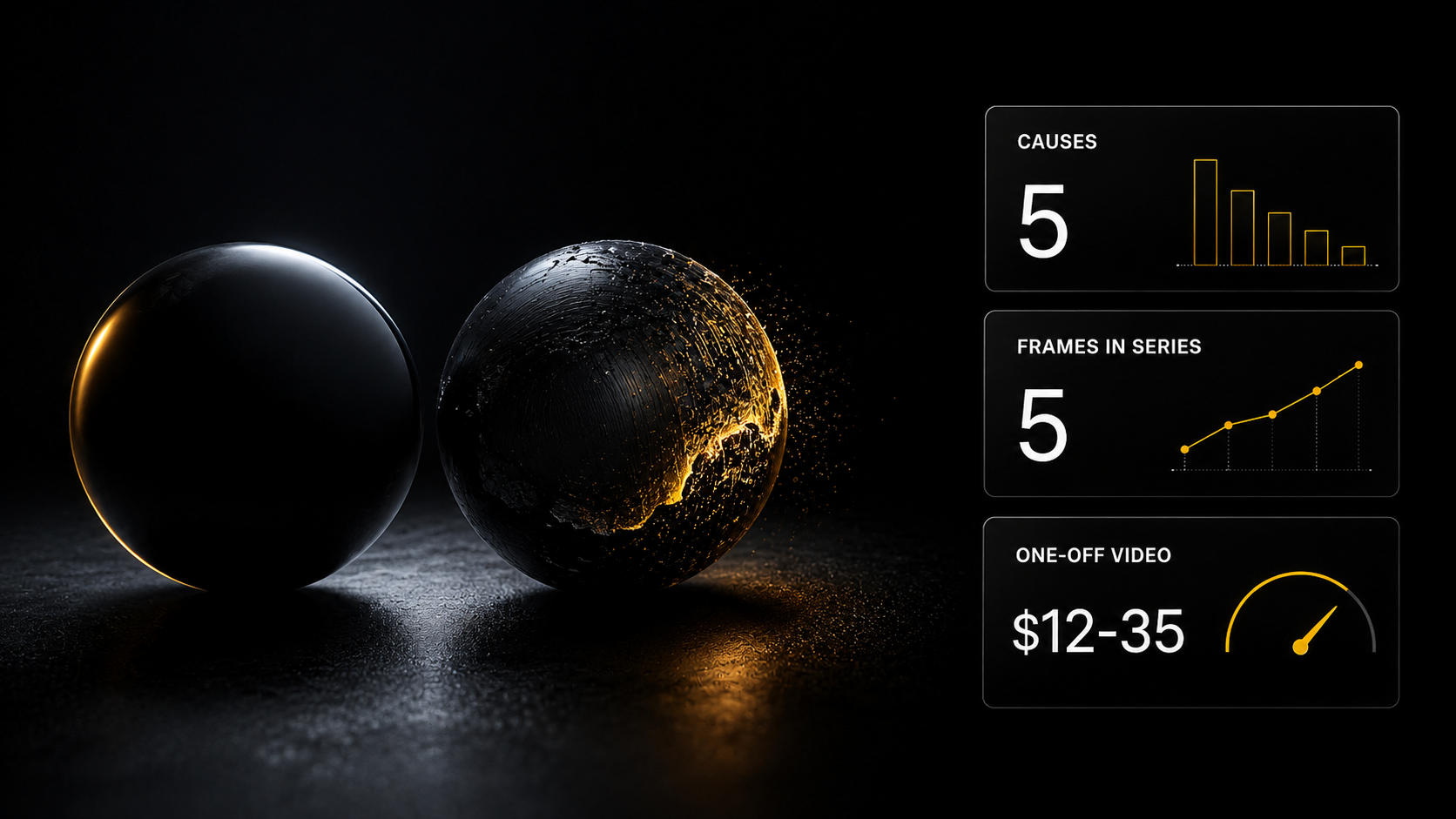
The frame is attractive, but within half a second anybody can see it is not a photograph — and the next frame gives you a different person. The first gets fixed with settings; the second only with a trained character. Below are five causes of the plastic look and why a consistent series matters more than realism.
The frame is attractive, but within half a second anybody can see it is not a photograph — and the next frame gives you a different person. The first gets fixed with settings; the second only with a trained character. Below are five causes of the plastic look and why a consistent series matters more than realism.
---
Attractive, but obviously not a person
You generated a character. The features are right, the light is even, the skin is smooth.
And any viewer works out within half a second that this is not a photograph.
Worse: the next frame gives you a different person. Similar, but not the same. A mole has gone, the shape of the nose has shifted, the age has moved five years. A series of ten frames cannot be assembled, and with no series there is no advertising campaign, no blog and no product listings.
Both problems are solvable, and solvable differently. The first with settings and post-processing. The second with an entirely different approach.
Five reasons a face reads as synthetic
1. Skin that is too clean
The main giveaway. By default a model produces a perfectly even surface with no pores, no small irregularities, not one blemish.
Living skin is uneven. The absence of texture registers as "plastic" before the brain has time to think.
What to do: ask for texture explicitly — pores, small imperfections, a naturally uneven tone. And do not overdo upscaling with smoothing: it often kills exactly what made the frame alive.
2. Light that is too correct
A studio setup with not one hard shadow looks like advertising rather than documentary.
Live frames almost always have a single source: a window, a lamp, sun from the side. The shadows are hard and part of the face falls into darkness.
What to do: specify a concrete source and time of day instead of "good lighting".
3. Symmetry
A model tends towards the ideal: both sides of the face identical, the eyes level, the smile even.
Living people always have asymmetry, and it is exactly what makes a face recognisable.
What to do: ask for slight asymmetry outright. It is one of those things that will not appear on its own.
4. Dead eyes
The hardest place for generative models. The eyes come out technically correct and empty: no micro-direction of gaze, no natural catchlight, none of what registers as attention.
What to do: specify where and how the person is looking — not "looking at the camera" but "looking slightly past the lens, as though listening to somebody". And judge a frame by the eyes first: if they do not work, nothing else will save it.
5. No context
The character hangs in emptiness or against a blurred background. A living person is always somewhere, with traces of life around them: mess on a desk, a cup, a reflection in a window.
What to do: describe the place, not only the person.
Which of these matters most
Texture and light. Removing only those two drops the synthetic quality noticeably. The rest refines the result, but that is where to start.
And a checking rule: look at the frame on a small screen rather than at full size. Your viewer will see it in a feed, compressed to a few centimetres. What jumps out at full size disappears there, and plastic skin and dead eyes stay visible.
The real problem is not the plastic look but the inconsistency
Everything above gets fixed by choosing the right phrasing. The main trouble is elsewhere.
Every new generation gives you a new person. You got a good frame, ask for a second in a different pose — and that is a different face.
Workarounds get you halfway. A reference can hold a general resemblance, but the details still drift. Fine for one frame, no good for a series of ten.
And commercial work is always a series. An advertising campaign, a set of listing images, a blog with a recurring character, a series of clips. One attractive frame is no use to anybody.
The solution: a trained character
The Gen AI section has character training — training a permanent character on your own images.
What that changes. A trained character is stored in your profile and dropped into any subsequent generation. The appearance does not change from frame to frame: the same person in another pose, another place, another light.
What that opens up:
- A series of frames with one character
- An advertising campaign in a single style
- A blog with a consistent face
- Clips where the character is recognisable from episode to episode
Alongside sit LoRA training — training your own visual style — and a voice trainer for cloning a voice for narration.
Three trained assets together — character, style, voice — give you what ordinary generators do not: recognisability.
Three sources of a character
If training is too early, there are simpler options.
Your own photo. You upload a selfie and become the character yourself. That works for an expert, a coach, an author: advertising with yourself in frame and no shoot.
Your own trained character. The permanent hero described above.
A ready avatar from the gallery — ten characters for different roles: cosy and lifestyle, youthful, business and expertise, kitchen and home, style and grooming, minimalism and tech, maker and DIY, city and sport, experience and trust.
Every avatar was generated by us. They are not stock people and not somebody else's faces — no rights questions arise. For commercial advertising that is not a detail but a condition of working at all.
What it costs
Generation is paid from your wallet on use rather than by subscription. The price of a particular model is visible before you press, and money is returned automatically on a failure.
The orders of magnitude: generating an image — $0.12–0.25, the photo editor — $0.12–0.50, animating a frame — from $0.17.
Set that against the market. By my scrape of 848 job listings, an image individually goes for $12–35, and a set of marketplace listing images for $245–730.
So the cost of generations in a job runs to single-figure percentages of the fee. The main thing is to build it into the quote from the start, the way a printer builds in paper.
What is needed for this
Gen AI — a section with 338 models in one place. Image generation — 30 models, the photo editor — 34, animating a frame — 84, Lip Sync — 13.
Character, LoRA and voice training — training your own assets, which then get dropped into any generation.
Prompt Master — if the phrasing will not come, the "improve prompt" button rewrites it to a methodology. That removes the main barrier: you do not have to be good at writing prompts to get the texture and light you want.
Marketing Studio — if what you need is not a frame but a finished advertising clip: you describe the offer, attach a product photo, choose a character and get a vertical clip with sound.
Image generation courses come with the Plus plan, or $9 one-off, or 1 000 experience points. They are not included in the three free days of Basic.
Registration is free and opens three days of Basic — every assistant, including the prompt generators in the creative category, and an encyclopaedia of more than 190 vetted services.
Where to start today
One action. Take your most recent generated portrait and look at it small — as a viewer will see it in a feed.
Then regenerate it with three additions: skin texture with pores, one hard light source, a gaze slightly past the lens.
The difference is usually visible on the first attempt. And after that the question is no longer realism but whether you can reproduce that face tomorrow — and that is solved only by a trained character.
---
A ready pipeline where consistency is already solved
Everything above is settings. There is a solution where consistency is built into the system itself.
The AI influencer with memory from the automations archive is built from three modules:
Creating the character — you set a name, a detailed biography and upload a reference photo that becomes the benchmark for the appearance.
The planner — the model analyses the character's personality and builds a seven-day content plan allowing for trends.
The visual engine — photorealistic selfies through Nano Banana, animation through Veo 3.1 into eight-second reels at 1080p.
The key property: the system does not simply draw pictures — it has memory, holds facial consistency and plans a week ahead itself.
Plus a technique from the Midjourney course
Character Reference. You upload a person's face or a mascot and the model remembers it. From there you place that character in an office, on the Moon, in a samurai costume, and the face stays the same. The strength of the resemblance is controlled with the `--ow` parameter.
Module 6 comes with the Plus plan; the pipeline with Make, N8N and Full.
---
What to read next
[Lip sync: making a character talk](/en/blog/lip-sync-talking-character) — the next step after a still frame.
[Your own visual style](/en/blog/train-your-own-style-lora) — carrying your manner into generation.
[How an AI influencer earns](/en/blog/ai-blogger-monetization) — four revenue models.
[Face rights in advertising](/en/blog/face-rights-in-ai-ads) — where an appearance can legally come from.
[AI video generation in 2026](/en/blog/ai-video-generation-guide) — the full guide to video models.
[AI video models in 2026](/en/blog/ai-video-models-2026) — what the models can do now and what of it sells.